






contact@dn.com
+86 135-7488-8887
3814848

Please scan the code using WeChat
On May 27, 2026, a globally renowned domain name trading platform released its latest weekly domain name sales rankings. Honeypot.com topped the global domain name sales charts for $150,000 (approximately RMB 1.08 million), becoming the most watched transaction of the week and highlighting the strong premium value of premium keyword domain names in the global market. Why was this transaction worth six figures? What makes a word associated with a "trap" attract buyers to spend so much money?

The buyer's identity in this transaction has not yet been disclosed, but considering the broader context of the 2026 domain name market—AI.com at approximately $70 million, workspace.com at $1.45 million, and nas.com at $1.25 million—HoneyPot.com's $150,000 price tag places it in the upper-middle range of premium keyword domains. The pricing logic is clear, and it's definitely not an impulsive purchase.
"Honeypot": One word, three worlds
While most domain names derive their value from a single industry anchor, HoneyPot is a rare cross-domain keyword—it possesses deep semantic roots in three distinct domains.
1. Cybersecurity: The most orthodox and professional use case
"Honeypot" is one of the core terms in cybersecurity, referring to a deliberately set decoy system used to lure attackers, capture attack behavior, and analyze attack methods. According to CrowdStrike, a honeypot is "a cybersecurity mechanism that uses a manufactured target to lure cybercriminals away from legitimate targets while simultaneously gathering intelligence about the adversary's identity, methods, and motives."
How important is honeypot technology in the security field? From a technical perspective:
Low-interaction honeypots: Simulate basic service ports to capture scanning behavior.
High-interaction honeypots: Deploy a complete operating system for deep tracing of attack chains.
Honeynets: A network environment composed of multiple honeypots, simulating an enterprise network architecture.
Global losses due to cyberattacks reach trillions of dollars annually, and honeypots, as a core component of proactive defense systems, are widely deployed by government agencies, intelligence departments, security research labs, and enterprise security teams. According to TechTarget, large enterprises and cybersecurity research institutions are the main users of honeypot technology.
For any company making cybersecurity products—threat detection, deception prevention, attack attribution—HoneyPot.com is a category-level brand domain, essentially turning industry terminology into a brand address.
2. Cryptocurrency and Blockchain: The Most Sensitive and Controversial Use Case
In the cryptocurrency and DeFi field, "Honeypot" has a completely different meaning—it is a malicious smart contract designed to allow users to buy tokens but prohibit them from selling, locking investors' funds in the contract. According to Greeks.live, honeypot scams are more insidious than standard Rug Pulls because investors cannot exit from the outset.
While this implication is negative, consider this in reverse: This is precisely why honeypot detection tools have become a necessity in the DeFi ecosystem. Platforms like ApeSpace offer Honeypot Checkers, which test whether a contract is a honeypot by simulating buying and selling. For any project providing on-chain security audits, contract testing, or anti-fraud tools, HoneyPot.com is a natural brand carrier—it both highlights the problem it addresses and implies the expertise to "identify" it.
3. Commercial and Consumer Brands: The Most Popular and Relatable Use Case
According to the Merriam-Webster dictionary, the first definition of honeypot is "something attractive or desirable," and the second is "a source of substantial funds." These definitions are extremely appealing in the business world—who wouldn't want to be defined as "attractive" and "well-funded"?
The most prominent example is The Honey Pot Company, a plant-based feminine care brand founded by Beatrice Dixon. Acquired by Compass Diversified in 2024 for $380 million, its products are available in 33,000 retail stores across the US. According to The Story Exchange, the brand uses thehoneypot.co instead of the .com suffix—meaning that if the buyer of HoneyPot.com were a brand in the same industry, its value would far exceed the transaction price.
HoneyPot.com's Industry Adaptability Matrix
Based on the above three semantic dimensions, we have outlined the most promising end-user industries and application scenarios for HoneyPot.com:
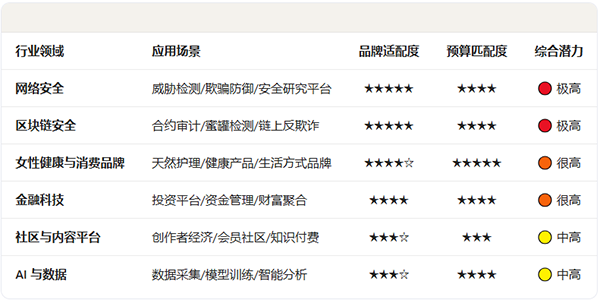
Cybersecurity and blockchain security are the perfect fit for HoneyPot.com, as the domain name itself is a category name; the potential for consumer brand scenarios is huge, but the cognitive anchoring of the term "honeypot" in a security context needs to be addressed.
The $150,000 pricing logic: Expensive or cheap?
To answer this question, we need to compare the market level of .com domains in 2026:
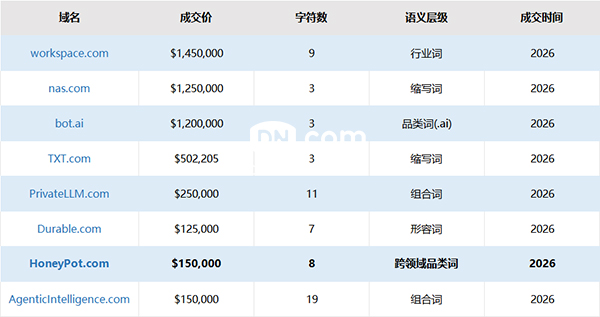
It's easy to see the following:
Extremely high character efficiency: 8 letters, 2 syllables, two words without hyphens, ensuring zero barriers to spoken communication—"Check out honeypot.com" can be said in a second without any spelling errors.
Semantic density far exceeds its peers: Compared to AgenticIntelligence.com (19 letters, 7 syllables) at the same price point, HoneyPot.com carries more than three times the semantic dimension with less than half the characters. There's an old saying in the domain investment world—"Every extra syllable is the enemy of traffic."
Compared to Durable.com: Both are common English words with 7-8 characters, Durable.com sold for $125,000, while HoneyPot.com sold for slightly more at $150,000. The premium comes from its "cross-domain category term" attribute—Durable is just an adjective, while HoneyPot is a core term in three industries.
The Gap with Top-Tier Deals: Compared to workspace.com's $1.45 million, HoneyPot.com's $150,000 seems restrained. However, "workspace" is a category keyword in the trillion-dollar enterprise software sector, while honeypot's largest category (cybersecurity), though large in scale, is more vertical. $150,000 is a rational but potentially underestimated price—if the buyer is an end-user in the cybersecurity field, the domain's commercial value could be 5-10 times the sale price.
Who is most likely to become the end-user buyer of HoneyPot.com?
Scenario 1: Cybersecurity Companies (Highest Probability)
The global cybersecurity market is projected to exceed $200 billion by 2026. Deception technology is one of the fastest-growing sub-sectors, with representative companies including Attivo Networks (acquired by SentinelOne), TrapX, and Illusive Networks. A company that makes honeypot products or deception technology platforms acquiring HoneyPot.com would essentially monopolize the category's entry point—much like Security.com did for the security industry in its early days.
Scenario 2: Web3 Security Infrastructure (Fastest Growth Rate)
On-chain security is shifting from "optional" to "essential." Honeypot detection, contract auditing, and anti-Rug Pull tools—when users search for "honeypot check" or "honeypot detector," HoneyPot.com naturally possesses a dual advantage in SEO and brand recognition. Imagine a positioning like "HoneyPot.com—the premier on-chain security testing platform"—the user's mental cost is virtually zero.
Scenario 3: Consumer Brand Upgrade (Largest Potential for Premium)
The Honey Pot Company currently uses thehoneypot.co. If the brand decides to upgrade to .com, the value of HoneyPot.com will no longer be priced according to the domain name market logic, but rather according to brand asset logic—a brand valued at $380 million paying hundreds of thousands or even millions of dollars for a matching domain name is commercially perfectly reasonable.
In conclusion: The "Honeypot Effect" of a Domain Name
The word "Honeypot" itself is full of metaphors—it's a gravitational field, luring attackers in the security field, attracting customers in the business world, and drawing investors in the domain name market.
The $150,000 price tag isn't high in the 2026 .com market, but it's definitely a signal with extremely high information density: what the buyer saw wasn't just an eight-letter combination, but a category entry point for three industries, a globally recognized technical term, and a brand container that can carry multiple business imaginings.
The core of domain name investment has never been buying characters, but buying semantic assets. The story of HoneyPot.com tells us that when a word is simultaneously a technical term, a security concept, and a business metaphor, its value isn't an either-or choice, but a combination of all three.
This, perhaps, is its own "honeypot effect."


 Contact Us