







contact@dn.com
+86 135-7488-8887
3814848

Please scan the code using WeChat
The sudden cessation of DNS resolution for Telegram's core shortened domain, t.me, has drawn global attention.
Many users discovered that previously ubiquitous links such as t.me/channel_name, t.me/group_name, and t.me/username are now inaccessible.
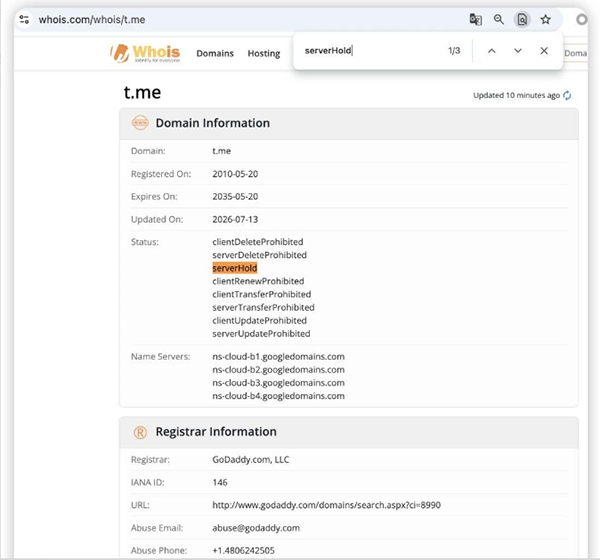
What's even more interesting is that Telegram itself didn't crash; the app worked normally, the servers were functioning, and messages were being sent and received as usual.
The real problem was with only one domain name, which might seem unbelievable to many.
How could a global platform with hundreds of millions of users experience such a massive chain reaction due to a single domain name issue?
But from the perspective of domain name investment and internet infrastructure, this precisely illustrates one thing:
To some extent, this incident demonstrates the power of a "unified entry point" on the internet.
In the early days of the internet, many companies used multiple domain names and entry points simultaneously. However, as brands have grown, more and more platforms have begun to concentrate traffic on a single core domain.
The benefits of this are obvious: it's easier for users to remember, brand communication is more efficient, and it's easier to establish a unified brand identity.
Telegram's choice of t.me is a perfect example of this. Compared to complex URL structures, a very short domain name is not only easier to spread but also more suitable for use in social media, chat software, and mobile scenarios.
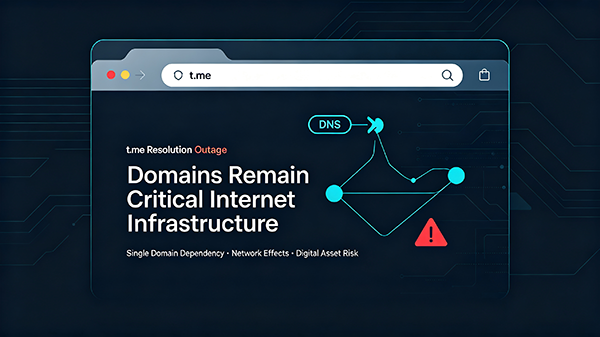
When all traffic, user relationships, and dissemination paths converge on a single domain, its importance is amplified exponentially. Any anomaly will have a correspondingly wider impact.
For the domain investment industry, the t.me incident once again proves a point: the true value of short domains doesn't solely stem from their scarcity of characters.
Many believe that two- or three-character domains are expensive due to limited resources. However, what truly makes a domain valuable is the network effect accumulated over a long period.
If a domain carries the browsing habits of hundreds of millions of users, billions of links, and massive external references, it becomes more than just a website address; it becomes infrastructure.
Today, anyone can register a new domain, but no one can replicate an entry point system that has accumulated years of user behavior and brand recognition.
This is why many top-level domains in internet history have continuously appreciated in value—because they carry not just traffic, but also long-term accumulated trust and connections.
While the t.me incident was only a brief anomaly, it serves as a reminder to the market that in today's rapidly developing world of apps, cloud computing, and even AI, domains remain an indispensable part of the internet's operation.
Technology may constantly evolve, and products may continuously iterate, but users' access to internet services still relies on the domain name system.
Normally, people rarely discuss the importance of domain names; however, when a core domain name suddenly becomes invalid, the entire ecosystem immediately feels its presence.


 Contact Us