contact@dn.com
+86 135-7488-8887
3814848

Please scan the code using WeChat
In July 2026, with the support of the Solana Name Service (SNS), the Solana Foundation officially submitted an application to ICANN requesting that .sol be recognized as an official general top-level domain (gTLD). If approved, .sol will join traditional suffixes such as .com and .org as the first blockchain-native domain name system to be officially included in the global DNS root zone. Users will be able to access alice.sol directly in their browsers, and this address can also be used as a wallet receiving address on the Solana blockchain.
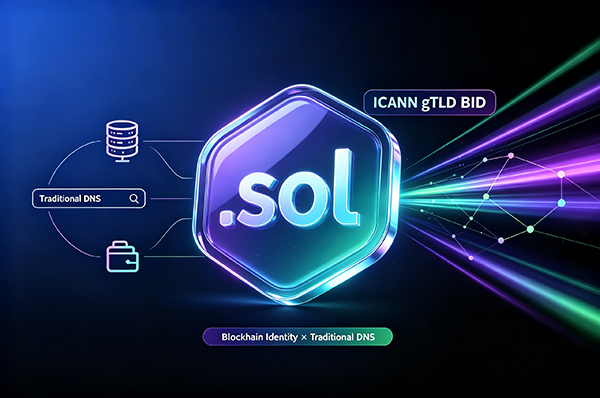
This means that a single name can simultaneously serve as both a Web2 website entry point and a Web3 on-chain identity.
Current Status: 450,000 on-chain domains, but the ecosystem is still in its early stages.
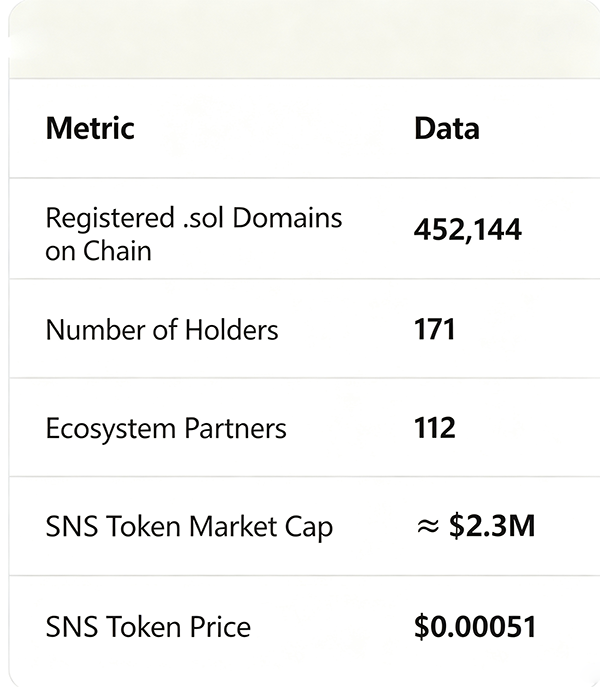
According to data from the SNS official website (sns.id), as of July 2026:
In contrast, the Ethereum ENS ecosystem:
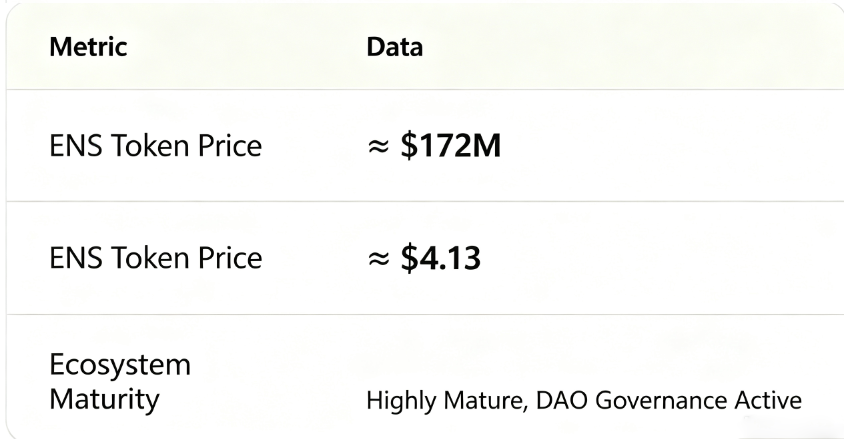
The gap is significant. While SNS has a certain base of on-chain registrations (450,000+), its holder concentration is extremely high (only 171 holders), and its token market capitalization is only 1.3% of ENS. This indicates that the .sol domain is currently more of a deployment by a small number of early users and has not yet generated genuine market demand.
Why is Solana doing this?
1. From On-Chain Tool to Internet Infrastructure
Currently, the .sol domain is only meaningful within the Web3 ecosystem—wallet address aliases, on-chain identities, and DApp entry points. However, once it enters the ICANN root zone, .sol will gain global DNS resolution capabilities: it can be directly accessed by any browser, any device, and any network.
This is a leap from a "blockchain gadget" to "internet public infrastructure."
2. Identity Layer of the AI Agent Economy
Solana is betting on the AI Agent economy. Its x402 protocol has attracted infrastructure providers such as AWS to integrate, allowing AI Agents to acquire data and services through on-chain micropayments. In this vision, the .sol domain name is not only a person's identity but also the identity of the AI Agent—each intelligent agent has a .sol address to receive payments, build reputation, and execute transactions.
3. Racing Against Competitors like Robinhood Chain
In the same week, Robinhood Chain launched its .hood domain name system, integrating wallet addresses, transaction profiles, and AI Agent identities under a single domain. Competition for blockchain namespaces is accelerating; whoever enters the traditional DNS system first will gain a first-mover advantage in terms of "legitimate identity."
Application Threshold: Starting at $227,000
ICANN's new gTLD application window for 2026 opened on April 30th and closed on August 12th—the first time a new gTLD application has been opened since 2012 (in 14 years).
Key Data:
Base Application Fee: $227,000 (approximately 1.63 million RMB)
Early Warning Report: 365 string intent reports have been received, covering 313 unique strings, of which 41 are competing applications.
October Publication: ICANN will publicly release all formal applications in October; private negotiations by applicants will be prohibited thereafter.
Subsequent Costs: After obtaining a gTLD, continuous obligations for registry operation are required (DNS infrastructure maintenance, ICANN compliance reporting, etc.).
For the Solana Foundation, $227,000 is merely the entry fee. The real cost lies in long-term technical operations and ecosystem promotion.
Community Reactions: Excitement and Skepticism Coexist
This news has sparked polarized reactions in the crypto community and domain investment circles:
Optimists:
"This will open the door to globalization for blockchain domains."
"If .sol succeeds, other blockchain projects will follow suit."
Some analysts believe that approximately 60% of developers and tech entrepreneurs may try blockchain identity verification.
Scary Views:
"What has actually changed? It seems like nothing has changed."
"What does this really mean? Can you explain in detail?"
Some question the definition of the "real internet"—is Solana currently just a "fake internet"?
The domain investment community takes a more pragmatic perspective: the key issue is not whether the technology is feasible, but whether there are enough end users who genuinely need .sol as their everyday website address. ENS has been developing for many years, and .eth has yet to enter the DNS root zone, indicating that the technical and governance difficulties of this path should not be underestimated.
Impact on the Domain Name Industry
Short-term (6-12 months)
Wait and see: The ICANN approval process is lengthy (assessment and authorization are expected to continue until 2027), and .sol will not appear in the browser address bar in the short term.
Concept hype: .sol-related domain names and SNS tokens may experience short-term fluctuations due to news, but it should be noted that the SNS market capitalization is only $2.3 million, with extremely low liquidity.
.SOL string competition: The ICANN Early Warning Report indicates that it is unclear whether there is multiple competition for .sol, but it is worth continued monitoring.
Mid-term (1-3 years)
Demonstration effect: If .sol is approved, Ethereum, BNB Chain, etc., are expected to follow suit and apply for .eth, .bnb, etc. gTLDs.
DNS system reform: Blockchain domain names entering the root zone will challenge the existing domain name registration-resolution-governance model.
Brand defense needs: Enterprises may need to register defensive domain names in the new blockchain gTLDs, creating new market demand.
Long-term
Identity layer integration: Web2 domains and Web3 Identity may be merging, with a single name simultaneously serving as a website address, wallet address, and AI Agent identifier.
Registry landscape reshaping: Traditional registries (Verisign, Identity Digital, etc.) may face new dimensions of competition.
A sober look at some real-world issues:
Who will manage DNS resolution? Even with ICANN approval, it will take time for browsers and operating systems to natively support .sol resolution. This is partly why ENS hasn't entered the root zone for years.
450,000 domains, 171 holders—this highly concentrated ownership distribution means a very fragile ecosystem. A shift in market sentiment could lead to large-scale abstentions.
SNS token $0.0005, market capitalization $2.3 million—supporting the long-term operation of a gTLD with this size presents a huge challenge.
The t.me incident just happened—Telegram's t.me domain was recently suspended by the registry due to OFAC compliance, reminding all services relying on a single domain system: decentralization is not just a slogan, but a survival strategy. Solana's push for .sol to be included in the DNS precisely represents the contradictory path of "moving from decentralized to centralized infrastructure."
Summary
Solana's application for the .sol gTLD is a landmark event—it represents a strategic shift in the blockchain industry from "self-built ecosystems" to "integration into the traditional internet." However, considering the reality of 450,000 on-chain domains, 171 holders, and a market capitalization of $2.3 million, this seems more like a strategic positioning move than an immediate market disruption.
For those in the domain name industry, the key focus is not on the success of .sol itself, but on the precedent it sets: if blockchain domains can be included in the DNS root zone, the registration, resolution, trading, and governance logic of the domain name industry will all need to be redefined.
Next step: After ICANN's application deadline of August 12th, will .sol and other blockchain-related strings appear in the official public list in October?


 Contact Us