






contact@dn.com
+86 135-7488-8887
3814848

Please scan the code using WeChat
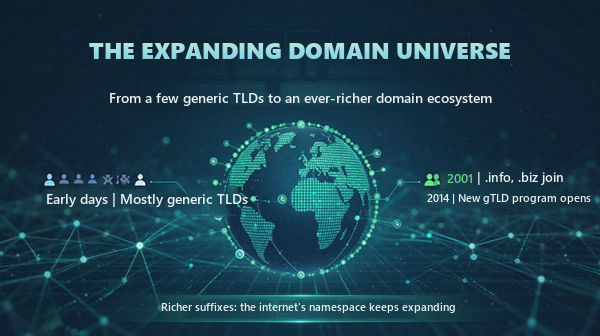
On March 15, 1985, the first-ever .com domain name—symbolics.com—was registered. That same year, .net, .org, and .edu, along with the first batch of country-code domains, also went live.
Since then, the domain name landscape has undergone several waves of expansion: the introduction of .info and .biz in 2001, followed by the launch of .xyz, .app, .vip, .top, and many others—all made possible by ICANN’s New gTLD (generic top-level domain) program, which began in 2014. To this day, an ever-growing number of new domain extensions continue to be released.
This raises a question: if all these domain extensions were brought back to the same starting line—with registration for each beginning on the very same day in 1985—would .com still claim the top spot?
Let’s first look at the current dominance of .com.
According to the latest *Domain Name Industry Brief* from Verisign (Q3 2026), the total number of domain name registrations worldwide has reached 411.6 million. Among them:
.com accounts for 169.8 million—a single extension representing approximately 41% of all domain names on the entire internet.
In second place is .cn, with 20.9 million—just one-eighth the size of .com.
In fact, .com has a larger footprint than the next nine "chasers"—.cn, .de, .net, .org, .uk, .xyz, .ru, .top, and .nl—combined.
There is another set of figures that is even more telling: renewal rates.
The Q3 report shows that the quarterly renewal rate for .com is 73.9%, while .org reaches as high as 86.3%. In contrast, .xyz—a leading player among the newer extensions—sits at only 17.8%, and .top is even lower, at just 12.5%.
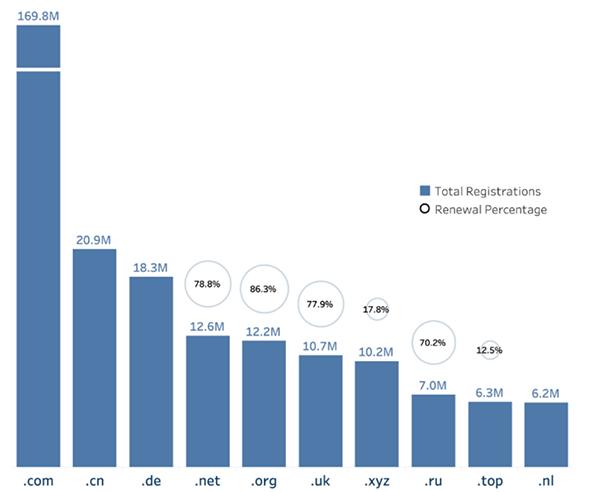
In other words, the high registration numbers for new domain extensions are largely driven by "low-price first-year promotions"—many people sign up, but few stay. In contrast, .com users are like long-term residents of an established neighborhood; they tend to stay for over a decade.
Why does .com win?
First, it wins on "semantic meaning."
.com stands for "commercial," .net for "network," and .org for "organization." Throughout the history of the internet’s commercialization, "commerce" has consistently been the primary demand.
For businesses registering a domain, .com is the most intuitive choice in terms of meaning. This advantage has little to do with it being the "first to arrive"—even if all domain extensions had been launched on the same day, the semantic niche for "commerce" would still have existed, and .com simply happens to occupy it.
Second, it wins on renewal rates.
New domain extensions are less like "challengers" and more like "transient traffic."
What truly determines the leader is not the number of first-year registrations, but rather how many users remain a decade later. A gap of 73.9% versus 12.5% is not something that would disappear simply because all the extensions had launched on the same day.

However, its advantage is not as secure as it appears.
First, consider the semantics: ".com" is not irreplaceable.
If all domain extensions had been launched on the same day, ".commercial" might not necessarily have emerged as the winner.
Today, extensions like ".web," ".online," and ".site" arguably feel more relevant to the very act of "going online" than ".com" does.
The semantics of ".com" are merely "a good fit"—not "one-of-a-kind." It occupies one of the best spots, but it is not the *only* spot.
Second, the rise of ".ai" proves that precise positioning can overcome the "first-mover advantage."
The ".ai" extension—originally the country code for Anguilla—wasn't launched until 1996, eleven years after ".com." By all logic, it shouldn't have stood a chance.
Yet, by January 2026, the number of ".ai" registrations surpassed 1 million—a 67% year-over-year increase—with seven-figure sales becoming a common occurrence in the secondary domain market.
An extension belonging to a tiny island with a population of under 20,000 managed, through its association with "artificial intelligence," to command prices in the capital market comparable to premium ".com" domains.
What does this tell us? Users aren't loyal to what is "old"; they are loyal to what is "right." If the starting line had been level, ".com" might not have been the "right" choice.
Therefore, the first-mover advantage is not the sole—or perhaps even the primary—reason for ".com's" dominance. Factors like semantics, mental positioning, and the stickiness of renewal cycles play a far greater role.
Even if every extension had launched on the same day, ".com" would likely still have come out on top. But without the benefit of 40 years of compounding, its dominance would certainly not be as overwhelming as it is today.
In such a scenario, the landscape would look more like a "multi-polar" market rather than one defined by a single, absolute hegemon.
Why is ".com" so difficult to unseat today? It holds a "triple crown" of advantages: the first-mover advantage, semantic relevance, and a dominant position in the public consciousness.
Any challenger lacking at least two of these three cards is destined to merely take a slice of the pie, rather than overturning the entire table.


 Contact Us