






contact@dn.com
+86 135-7488-8887
3814848

Please scan the code using WeChat
Recently, a series of noteworthy corporate moves have emerged within the global domain name market.
From Shopify migrating its "Shop" shopping platform to Shop.com, to Clarity’s $3.5 million acquisition of Clarity.com, and the strategic adoption and upgrading of domains like ASI.com, Bolt.com, and Transcosmos.com—while these events span different industries, they all point to a common trend:
Domain names are evolving from mere internet addresses into vital assets for corporate brand strategy and business operations.
I. More Than Just a URL: The Domain as a Gateway to the Brand
Shop.com stands out as one of the most notable recent examples.
Shopify migrated its "Shop" platform—an ecosystem encompassing cross-brand search, shopping carts, payments, and order tracking—from Shop.app to Shop.com. In this context, Shop.com serves as more than just a concise URL; it acts as a crucial gateway connecting consumers to commercial services.
Clarity.com illustrates a different value proposition.
After rebranding from Hiive, a platform for trading private equity shares, to "Clarity," the company invested $3.5 million to acquire the domain Clarity.com and migrated its official website to this new address.
For sectors like fintech, where professionalism and trust are paramount, aligning a brand name with its domain name helps lower the cognitive cost for users to identify the brand, while also mitigating the risks posed by counterfeit or imposter websites.
This underscores that the value of a premium domain name extends beyond traffic generation and memorability—it plays a fundamental role in a company’s long-term brand-building efforts.

II. Brand Upgrades Often Go Hand in Hand with Domain Upgrades
There have been several noteworthy cases involving brand domain names recently.
ASI.com: Air Space Intelligence rebranded as "ASI." Concurrently, the company secured $325 million in Series C funding, reaching a valuation of $3 billion, and upgraded its brand domain to the three-letter "ASI.com." Aligning a short, concise domain name with the corporate brand helps cultivate a streamlined, international brand identity.
Bolt.com: The U.S. payment technology firm Bolt migrated its official website to "BoltApp.com," while the European mobility platform Bolt acquired "Bolt.com." This shift serves as a reminder that companies must maintain a clear strategic alignment between their brand name, domain ownership, and actual business operations.
Transcosmos.com: The Japanese firm transcosmos transitioned its primary domain from "trans-cosmos.co.jp" to "Transcosmos.com." Removing the hyphen and adopting the globally recognized ".com" extension helps unify brand recognition across international markets.
These examples illustrate that as companies reach certain stages of development, they often re-evaluate their digital brand assets. A domain upgrade is no longer merely a technical migration; it has become an integral component of a company’s global branding strategy.
III. The Value of Domain Names in Brand Defense and Future Positioning
Beyond their direct use for official websites or product access points, domain names possess another often-overlooked value: brand protection.
Recently, "Thead.com" showed technical configuration traces linked to "Pingtouge" (T-Head)—a business unit under Alibaba. While there has been no official confirmation regarding its intended brand use, the situation remains worth monitoring.
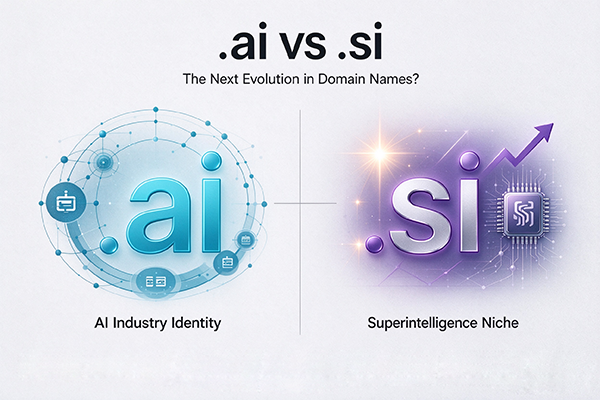
Another transaction of interest involves "Lambda.si." According to public sales records, the domain was acquired for $100,000 by the entity behind "Lambda.ai," which already held the corresponding ".ai" domain.
If this acquisition was driven primarily by a defensive strategy, it highlights yet another dimension of domain asset value: even in the absence of an immediate, direct need for use, a company may choose to acquire relevant domains to mitigate the risk of future brand confusion or competitive encroachment.

IV. The Domain Market Is Shifting from a Focus on Transactional Logic to Corporate Application Logic
A look back at recent events reveals a shift that warrants the industry’s attention:
In the past, the domain market was primarily concerned with which domains were registered, which were sold, and the prices at which they traded.
Today, an increasing number of enterprises are incorporating domain names into their broader strategic planning—encompassing brand upgrades, global operations, user acquisition, and digital asset management.
From global commercial gateways like Shop.com and strategic brand assets like Clarity.com, to domains serving defensive branding purposes—such as Lambda.si—different types of domains are delivering distinct business value.
For the domain industry, the truly significant question is not merely the price at which a domain is sold, but rather why an enterprise chooses to acquire it and what value it can generate for that business.
As AI, digital commerce, and global brand competition continue to evolve, new products and enterprises will inevitably emerge. Their demand for brand names, independent websites, and digital gateways is likely to create fresh opportunities within the domain market.
Ultimately, the value of a domain name must be demonstrated through its practical application in real-world business.


 Contact Us