







contact@dn.com
+86 135-7488-8887
3814848

Please scan the code using WeChat
In mid-September 2026, WIPO released two consecutive UDRP decisions in which the trademark holders lost in both instances. In one of these cases, not only was the complaint dismissed, but the three-member panel also unanimously determined that the complaint constituted Reverse Domain Name Hijacking (RDNH). These cases serve as a renewed reminder to the industry that the UDRP is not an "automatic domain-recovery tool" for trademark owners; prior registration combined with legitimate use remains the strongest line of defense.
Case 1 involved a complaint filed by the German building materials company Otto Lehmann GmbH regarding the domain *lehmann.com*; Case 2 involved a complaint filed by the French HR consultancy NOOUS, SAS regarding the domain *noous.com*. The core logic in both cases was highly consistent: the domain registration predated the trademark application or registration date by a significant margin, and the complainants failed to demonstrate that the domain was registered with bad faith targeting their trademarks.

Case 1: lehmann.com — Trademark registered after the surname domain; Complainant found to have engaged in RDNH
The Complainant, Otto Lehmann GmbH, was established in 1969 and deals in construction materials such as roofing, drainage, surface treatment products, and solar mounting systems. Its EU figurative trademark "LEHMANN" was applied for on September 4, 2025, and registered on January 11, 2026—meaning the basis of its rights is very recent.
The disputed domain name, lehmann.com, was registered much earlier, on December 10, 1996. In 2006, Tucows acquired a portfolio of over 17,000 surname domains—including this one—for approximately $18 million and utilized them for a surname-based email service (providing email addresses to users with the surname "Lehmann"). This was a long-standing business model for Tucows and was not targeted at the Complainant's brand.
The parties had communicated prior to the filing of the complaint. Tucows had clearly explained the domain's origin, its method of use, and its history of successfully defending against UDRP actions. Despite this, the Complainant initiated arbitration and omitted key details of the correspondence from its submission.
The three-member panel (chaired by Wilson Pinheiro Jabur, with Andrea Jaeger-Lenz and Sally Abel) unanimously determined that:
While the Complainant satisfied the requirement regarding trademark rights (the first element), the Respondent held legitimate interests in the domain name; its use constituted a bona fide offering based on the inherent nature of the surname and its long-term operation of an email service.
There was no evidence of bad faith registration or use directed at the Complainant. The domain was registered in 1996, whereas the Complainant did not apply for its trademark until 2025; chronologically, it is impossible to establish that the domain was registered with the intent to target the Complainant's trademark.
The Complainant was represented by counsel and should have realized that the case was unlikely to satisfy the policy's three elements; proceeding with the complaint nonetheless constituted Reverse Domain Name Hijacking (RDNH).
The panel specifically noted that the Complainant's argument—that Tucows' industrialized business model treated the domain merely as a tradable asset rather than a genuine bona fide use of the "LEHMANN" mark—was not supported by the precedents it cited.
The Respondent was represented by John Berryhill, a prominent U.S. domain name attorney. This was not the first time Tucows' surname domain portfolio has prevailed in UDRP proceedings; similar reasoning has been upheld in numerous previous cases. Case 2: noous.com—A domain registered in 2009 versus a 2025 trademark
Another ruling reported on the same day involved the case of NOOUS, SAS v. noous.com (WIPO Case No. D2026-2775).
The Complainant is a French human resources consultancy that began using the name "NOOUS" in January 2020 to operate the site noous.co; its French trademark was registered on October 24, 2025. The disputed domain name, however, was registered in 2009—approximately 11 years before the Complainant adopted the name and 16 years before the trademark was registered.
Sole Panelist Matthew Kennedy determined that, at the time the Respondent registered the domain name, the Complainant held no trademark rights and had not even adopted the trade name; therefore, there could be no bad faith registration directed at the Complainant's rights. As the third element was not established, the complaint was denied.
The Panel further found the Complainant guilty of Reverse Domain Name Hijacking (RDNH): the Complainant was represented by legal counsel and was aware that the domain registration predated its trademark rights by a wide margin, yet it downplayed key timing information—such as the trademark registration date—in the complaint itself and persisted with the action, thereby imposing a burden on the Respondent to defend the case.
This illustrates a fundamental principle repeatedly emphasized in UDRP proceedings: bad faith must exist at the time the domain name is registered (or acquired). Trademark rights arising subsequently cannot retroactively alter the nature of a registration act performed years earlier.
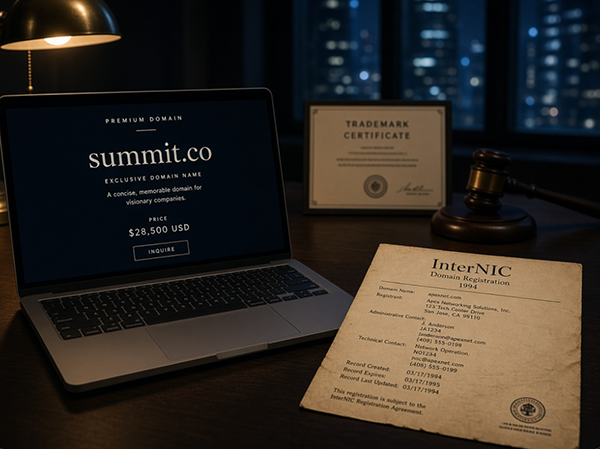
Why These Two Cases Deserve Close Attention from the Domain Industry
Two consecutive cases resulting in losses for trademark holders—with one explicitly labeled as Reverse Domain Name Hijacking (RDNH)—have further dispelled the notion held by some practitioners that trademark holders naturally hold the upper hand in UDRP proceedings.
For Domain Investors/Holders:
Prior registration serves as the first line of defense. A registration date that predates the trademark application date often effectively cuts off any argument regarding "bad faith registration."
Consistent and justifiable use is crucial. Tucows’ surname-based email service was deemed a legitimate use; long-term holding is not inherently wrongful—the key lies in demonstrating a rational business logic for the registration and use.
Maintain records of communication. If the respondent clearly stated the basis of their rights and their defense position prior to the dispute, and the complainant nonetheless insisted on filing the case while selectively disclosing materials, this becomes a factor supporting a finding of RDNH.
When facing a complaint with little chance of success, one can proactively request that the panel make a finding of RDNH. While an RDNH finding does not result in monetary compensation, it creates an industry record and raises the cost for the other party to file future or abusive lawsuits.
For Brand Owners/Trademark Holders:
Prioritize acquisition; use arbitration as a fallback. When a domain has existed for years and the holder has a plausible narrative of legitimate use, negotiating a purchase is usually a safer bet than immediately resorting to UDRP.
Carefully calculate the timeline first. If your trademark application or use date is later than the domain registration date, the case will almost certainly fail on the third element; forcing a complaint in such instances carries a high risk of being deemed an abuse of process.
Ensure materials are complete and accurate. Omitting unfavorable correspondence, downplaying critical dates, or misciting precedents will be viewed by the panel as indicators of a bad-faith complaint.
UDRP is not a "fast track" to assert trademark rights over domain rights; rather, it is a limited remedy addressing bad-faith cybersquatting that existed at the time of registration and use. Using a later-registered trademark as a weapon to seize a pre-existing domain carries a risk that is increasingly manifesting as RDNH findings.
Industry Takeaway: The Boundaries of UDRP Are Clearer Than You Think
These two cases do not negate trademark protection, nor do they grant domain investors a "get-out-of-jail-free card." These decisions reaffirm the structural framework that has defined the UDRP since its inception: three specific elements must be satisfied concurrently. Crucially, the assessment of "bad faith registration" focuses on the registrant's state of mind at the time of registration, rather than the trademark's current level of fame.
For investors, the most prudent strategy remains a combination of early registration, a defensible rationale for use or holding, and well-documented communications. For brand owners, the safest approach involves securing core domains early, prioritizing market-based acquisitions over dispute proceedings, and carefully evaluating the timeline and the counterparty's potential defenses before initiating a case.
While a trademark application can be filed at a later date, the domain registration date cannot be backdated. When a conflict arises, the administrative panel does not consider "who is more famous now," but rather "whether the other party targeted you at the time of registration." This principle is clearly reiterated in the two rulings from September 2026.


 Contact Us