






contact@dn.com
+86 135-7488-8887
3814848

Please scan the code using WeChat
ENS is entering a new phase that warrants the attention of the domain name industry.
The ENS DAO has completed the "Next Era of ENS DAO" governance overhaul; the ENS Foundation has officially transitioned into a full-time operational entity, adopting a structure comprising a five-member board and a dedicated executive director. Meanwhile, core control over the ENS protocol itself remains in the hands of token holders.
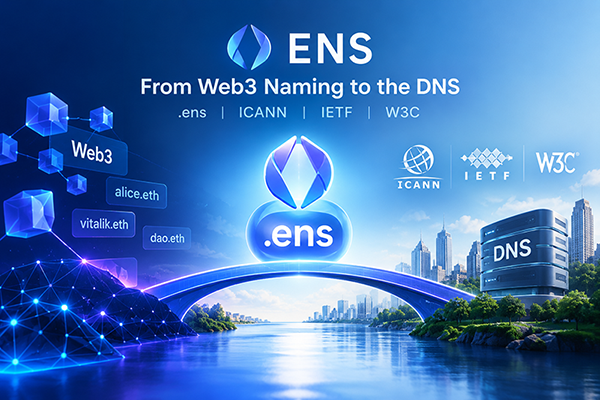
Of particular note is the Foundation's role in bridging ENS with the traditional internet infrastructure—including participation in discussions with ICANN, the IETF, and the W3C—and its efforts to secure recognition and management rights for ".ens" as a top-level domain.
This signifies that the strategic focus of ENS has expanded beyond mere blockchain wallet addresses and Web3 identities.
Should ".ens" ultimately be integrated into the traditional DNS framework, a genuine connection between Web3 naming systems and the conventional domain name system could emerge.
Of course, this path remains fraught with technical, policy, and governance challenges; the current situation does not imply that ".ens" has already received ICANN approval.
Nevertheless, a compelling question now confronts the domain name industry:
Will the future internet feature the parallel existence of DNS and Web3 naming systems, or will they eventually converge?
The next steps taken by ENS may well serve as a crucial window for observing this trend.


 Contact Us