







contact@dn.com
+86 135-7488-8887
3814848

Please scan the code using WeChat
The domain name industry has seen another instance of a new gTLD being withdrawn. According to a report by Domain Incite, Qihoo 360 (Beijing Qihoo Technology) has submitted a request to ICANN to terminate the registry agreement for the .xihuan top-level domain. Although this suffix—derived from the Pinyin for "like" (or "to love")—entered the DNS root zone back in 2016, it never opened for registration or officially launched during the ensuing decade; Qihoo 360 has not publicly disclosed the specific reasons for terminating the TLD.
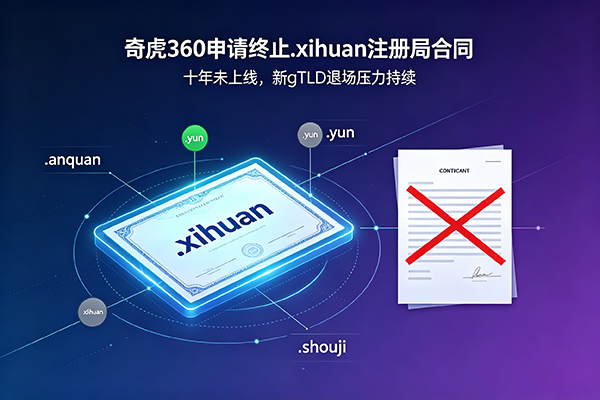
360’s Pinyin gTLD Portfolio: Only .yun Has Successfully Launched
Looking back at the 2012 wave of new gTLD applications, Qihoo 360 secured several Chinese Pinyin generic top-level domains (gTLDs)—including .xihuan, .anquan (security), .yun (cloud), and .shouji (mobile)—all aligned with its business operations. At the time, this set of Pinyin-based extensions attracted significant industry attention.
However, the current status of these extensions varies widely:
✅ .yun: Officially opened for registration last year; the zone file currently contains approximately 2,700 domains.
❌ .xihuan: Existed in the root zone for a decade without ever launching; a contract termination has now been requested.
⏸ .anquan, .shouji: Registry contracts remain in place, but public registration has not yet commenced.
The industry had high hopes for these Pinyin TLDs, believing they could leverage the domestic internet ecosystem to build a localized TLD system. In reality, however, aside from the limited launch of .yun, the other extensions remained idle—"delegated but not operated"—for extended periods, with .xihuan ultimately opting to exit entirely.
Not an Isolated Case: A Wave of Exits for New gTLDs
The termination of .xihuan is not an isolated incident but part of a broader trend of clearing out legacy assets from the 2012 new gTLD program. Recently, the City of Helsinki applied to terminate .helsinki, while Budapest and Doha also abandoned their respective city-based gTLDs. Operators are proactively asking ICANN to terminate registry agreements for many TLDs that were originally secured at great expense.
When applications for new gTLDs opened in 2012, enterprises and municipal bodies worldwide applied enthusiastically, resulting in the creation of over a thousand new extensions. Yet, as the initial hype faded, many registries faced ongoing annual contract and maintenance costs, while market acceptance and registration volumes fell far short of expectations. Many TLDs were merely delegated in the root zone without undergoing actual promotion or registration, becoming what the industry calls "hoarded but unused" assets. Faced with persistent fixed costs, many holders have chosen to cut their losses and exit. Under ICANN procedures, when a registry operator voluntarily applies to terminate its registry agreement, the request enters a public comment period during which ICANN assesses whether a successor operator is needed to take over the TLD. In the case of .xihuan, ICANN made a preliminary decision not to seek a successor; consequently, upon contract termination, the TLD will be removed from the DNS root zone and taken offline permanently.
Industry Perspective: The Ideal vs. Reality of Pinyin gTLDs
Pinyin-based TLDs theoretically offer local brand value; they are easy to pronounce and understand, aligning well with the habits of Chinese internet users. However, years of experience have shown that a favorable literal meaning is far from sufficient. For a TLD to survive, it requires sustained investment in the ecosystem, end-user acceptance, supporting registration channels, and clear, practical use cases.
Since the bursting of the 2012 new gTLD bubble, industry consensus has shifted: merely securing TLD rights does not equate to value. TLDs that fail to achieve practical adoption, lack end-user demand, and incur ongoing costs are ultimately destined for decommissioning. The demise of .xihuan serves as a lesson for companies holding idle new gTLDs: TLDs are not permanent assets; long-term dormancy entails ongoing costs, and cutting losses at the right time is becoming the norm.
Note: The original report mentioned that the U.S. Department of Defense designated Qihoo 360 as a "Chinese military company"; this information is cited directly from foreign media, and this article expresses no position on the matter.


 Contact Us