






contact@dn.com
+86 135-7488-8887
3814848

Please scan the code using WeChat
Recently, Darpan Munjal shared a set of sales data on the social platform X that sparked heated discussions: the sales volume of domain names priced at $25,000 and above is almost twice that of domain names priced at $2,500. This data comes from STR, which directly reveals the long-term trend of "quality over quantity" in the domain name market, and also provides a new direction for small and medium-sized investors to think about.
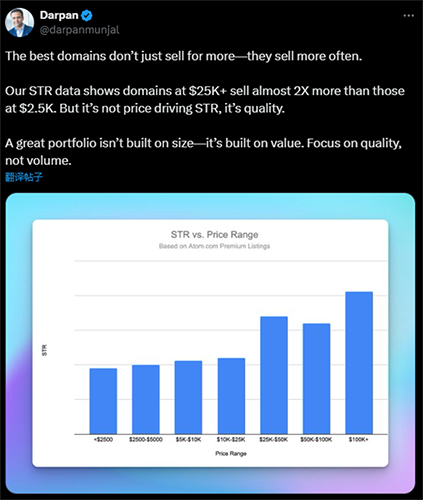
According to the chart released by Munjal, the phenomenon of high-priced domain name transaction volume leading significantly is not accidental. We can find out from the analysis of such domain names that they usually have the following characteristics: short and easy to remember, prominent industry keywords, authoritative suffixes (such as .com/.net), and often correspond to high-value business scenarios (such as finance, technology, luxury goods, etc.). For example, the sky-high-priced domain names such as "chat.com" and "AI.com" that have been sold in recent years have become scarce resources that companies are vying for because they accurately match the industry trend.

At the same time, although low-priced domain names (such as the $2,500 tier) have a high transaction frequency, the buyer group is scattered, and the demand is mostly concentrated on personal blogs, small projects or short-term use, making it difficult to form a stable commercial value.
However, this phenomenon also brings some questions. Although high-priced domain names have good sales, the number of buyers in the market who can afford to buy these domain names may be relatively limited, which means that there may not be many valuable shoppers. So, can the market demand for high-priced domain names continue? How can low-priced domain names break through the difficulties and find their own market positioning?
Therefore, for domain name investors, when making investment decisions, they should not only focus on the price of the domain name, but also deeply analyze the quality, market demand and development potential of the domain name. For domain name sellers, whether it is a high-priced domain name or a low-priced domain name, they need to continuously improve the quality and service of the domain name to meet the needs of different customers.


 Contact Us