







contact@dn.com
+86 135-7488-8887
3814848

Please scan the code using WeChat
In many countries/regions, the usage frequency of country code top-level domains is higher than .com, and this is understandable. In the United States or China, you almost always see domain names ending in .com rather than the country's .us domain extension.

However, not all countries follow this pattern. Traveling around Europe and parts of South America, the situation is quite different. In many places, you are more likely to see country code domains rather than .com.
In China, where we live, .cn is our country code top-level domain, but looking around, many companies use .com domain names, and few private enterprises use .cn. Upon closer inspection, you'll find many public institution websites using .cn/.com.cn domain names, but they still have a relatively low percentage internationally.
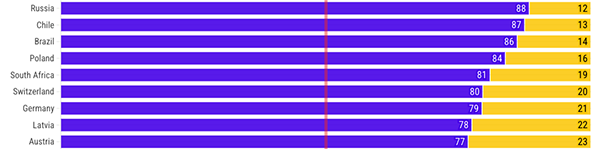
For example, in Germany, you are more likely to see .de than .com: .de accounts for 79% of the country's websites, while .com makes up 21%. (This analysis only compares ccTLDs with .com, not other top-level domains).
This should not surprise anyone who has visited Germany. .De is a very popular domain, with a registration volume exceeding 15 million. DataProvider.com's analysis shows that the countries with the most concentrated use of ccTLDs are Russia, Chile, Brazil, Poland, and South Africa.
Why are many countries reluctant to use their own country code top-level domains?
1. Globalization Demands:
Many businesses and organizations operate globally, and using generic top-level domains (gTLDs) such as .com, .net, .org, etc., helps convey an international image rather than being limited to a specific country.
2. Domestic Market Competition:
In some countries, country code top-level domains may be influenced by domestic market competition. For example, in China, .cn is the country's ccTLD, but many companies and individuals prefer .com because it is more universally recognized internationally.
3. Domain Availability:
Some country code top-level domains may face issues with limited domain availability. Some short and meaningful domain names may already be registered, making it challenging for users to obtain the domain they desire.
4. Brand Recognition:
Some country code top-level domains may lack global brand recognition. Globally recognized domains like .com are more easily identified by users worldwide as they are widely used on the global internet.


 Contact Us