






contact@dn.com
+86 135-7488-8887
3814848

Please scan the code using WeChat
Recently, ByteDance founder Zhang Yiming topped the 2026 list of China’s wealthiest individuals with a net worth of 670 billion yuan, once again drawing market attention to this prominent internet entrepreneur.
From Toutiao and Douyin to TikTok, and more recently the rapidly growing AI product Doubao, ByteDance has built a global product matrix spanning content, social media, short-form video, workplace tools, and artificial intelligence.
Beyond these well-known brands lies an aspect of the company’s strategy that warrants the attention of the domain name industry: its portfolio of domain assets.
For an internet giant with operations spanning the globe, a domain name is far more than just a technical gateway to a website; it is a vital component of brand identity, user outreach, and digital asset management.
I. From Domestic to Global: ByteDance’s Brand Domain Matrix
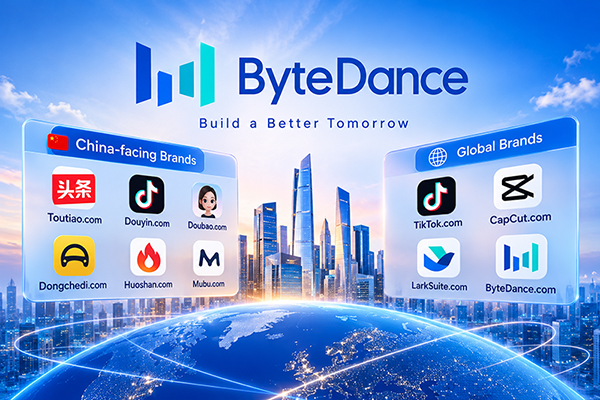
An examination of ByteDance’s key products reveals a distinct approach to its domain strategy: the company employs separate branding systems for its domestic and overseas operations, while establishing dedicated brand gateways for its core products.
1. Core Domestic Business: Pinyin-based Brand Domains
In the domestic market, many of ByteDance’s prominent products utilize ".com" domain names based on the Pinyin (Romanized Chinese) spelling of their brand names.
Toutiao.com — Toutiao
Douyin.com — Douyin
Doubao.com — Doubao
Dongchedi.com — Dongchedi
Huoshan.com — Huoshan
Mubu.com — Mubu
These domains encompass a diverse range of sectors, including news and information, short-form video, artificial intelligence, the automotive industry, and productivity tools.
Among these, Toutiao.com and Douyin.com have become widely recognized brand domains, while Doubao.com—gaining prominence alongside the rise of large-scale AI model applications—serves as a notable example of an AI-focused brand domain.
These domains share a common trait: they correspond directly to the product brands, making them easy for users to remember, recognize, and access.
For Chinese-speaking internet users, Pinyin-based brand domains continue to offer unique advantages. High-quality two-syllable Pinyin ".com" domains, in particular, strike an ideal balance between brand relevance, ease of input, and commercial utility.
2. Global Operations: Independent English-Language Brand Domains
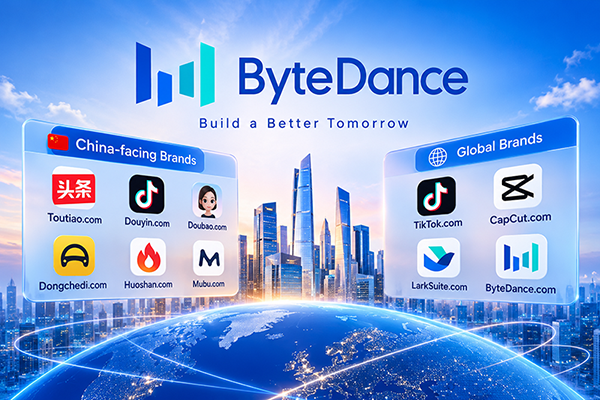
As ByteDance accelerates its global expansion, its overseas products have gradually developed an independent, English-language brand ecosystem.
TikTok.com — The global short-video platform, TikTok
CapCut.com — The video-editing tool, CapCut
LarkSuite.com — "Lark," the overseas brand for the enterprise collaboration platform Feishu (known as Lark internationally)
ByteDance.com — The official global website for ByteDance
Unlike its domestic operations, which often favor brand domains based on Pinyin (the romanization of Chinese characters), the company’s overseas products primarily utilize concise, easily communicable English brand names.
This approach reflects the company’s attentiveness to the habits of users in different markets and demonstrates that there is no single, universal standard for domain selection. For a global enterprise, a domain strategy must holistically integrate brand names, target markets, and user perception.
II. Three Industry Logics Behind ByteDance’s Domain Strategy
If one looks only at the surface value of these domains, they might appear to be nothing more than corporate websites or product gateways.
However, from the perspective of the domain industry, this strategy reveals at least three noteworthy trends.
1. Strong Alignment Between Brand and Domain: Reducing User Recognition Costs
A cornerstone of brand building is ensuring that users can quickly remember the company.
When a brand name aligns with its domain, users find it much easier to establish a connection between the two.
For instance, when users encounter "Douyin," they naturally associate it with "Douyin.com"; similarly, seeing "TikTok" leads them directly to "TikTok.com."
This consistency not only facilitates brand communication but also lowers the cognitive effort required for users to locate the official website.
For startups, considering the corresponding domain name at the same time as choosing a brand name is a crucial step.
2. Proactive Domain Strategy: Avoiding Future Complications as a Brand Grows
A new product may be relatively unknown in its early stages, but should it gain a large user base, both its brand value and the commercial value of its associated domain name will likely rise.
Attempting to change a domain or acquire a preferred brand-aligned domain after a product has already amassed a massive user base often entails significantly higher costs and complex challenges related to brand migration.
Therefore, a company’s domain strategy should not be an afterthought following a product launch; rather, it should be an integral part of the overall brand planning process.
Securing a high-quality domain that perfectly matches the brand early on is a strategic, long-term investment. 3. A Tiered Strategy for Domestic and Overseas Markets to Meet Diverse Needs
ByteDance employs distinct branding approaches for its domestic and international product portfolios.
For its domestic operations, the company utilizes Pinyin-based domain names, which align with the linguistic habits of Chinese-speaking users. Conversely, for its overseas operations, it adopts concise, English-language domain names, facilitating smoother integration into international markets.
This offers a key insight for businesses: a domain name strategy should not merely focus on the immediate requirements of a corporate website; rather, it should be planned with future business expansion, international brand development, and market positioning in mind.
III. The True Value of Domain Names: Lessons from the ByteDance Case
The case of ByteDance prompts us to reconsider a fundamental question:
In an era defined by the rapid evolution of AI and the internet, what is the actual value of a domain name?
The answer is clear.
Regardless of how technology shifts, businesses will always require a stable, distinct, and trustworthy brand identity.
From the traditional internet to the mobile internet, and now to the age of AI-driven applications—while the ways in which users access information and interact with products have evolved, the importance of brand recognition, user trust, and digital gateways remains undiminished.
This is especially relevant given the explosive growth of AI applications, which has led to the emergence of countless new brands and products.
For these enterprises, a concise, memorable domain name that aligns with their brand identity serves as a vital foundation for brand building.
Furthermore, domain names are inherently scarce. High-quality .com domains, premium Pinyin-based names, short character combinations, and generic terms with clear commercial significance possess strong brand-alignment potential and sustained market demand.
From the perspective of domain investment, analyzing the branding strategies of industry leaders provides valuable insight into the genuine demands of the end-user market. Rather than chasing fleeting, short-term trends, it is arguably more meaningful—in the long run—to observe which sectors companies are entering, which brands are gaining traction, and what kind of digital gateways these brands require.
IV. Insights for Entrepreneurs and Domain Investors
ByteDance’s domain strategy does not imply that every company needs to amass a vast portfolio of domain names; however, it does underscore one critical point:
Domain names should not be an afterthought, considered only after a company has achieved success.
For entrepreneurs, the availability and commercial value of a corresponding domain name should be evaluated concurrently with the selection of a brand name and product direction. Securing a domain name that supports long-term growth should be a priority from the very beginning. For established enterprises, the protection of core brand domain names, the strategic planning of domain names for related business lines, and the centralized management of brand access points—both domestically and internationally—should be integrated into a long-term brand strategy.
For domain investors, the evolution of corporate brands remains a primary driver of end-user demand. By focusing on high-quality brand terms, industry-specific keywords, premium Pinyin-based domains (double-Pinyin), and English-language domains with global appeal—while conducting in-depth research into genuine end-user needs—investors can better capitalize on market opportunities.
In conclusion
From Toutiao.com and Douyin.com to Doubao.com and TikTok.com, the domain names associated with ByteDance’s brands illustrate the vital role that domain names play in corporate brand building and global expansion.
Zhang Yiming has built a world-class internet enterprise, and these domain names—tightly aligned with his brands—have become a noteworthy component of the company’s digital brand ecosystem.
While a company may continuously launch new products and enter new markets, a strong brand domain name often remains a constant, accompanying the brand throughout its long lifecycle.
For any enterprise, a domain name is not merely an online gateway for today; it is also a significant digital asset for the future.
This is precisely where the long-term value of a high-quality domain name lies.


 Contact Us