

contact@dn.com
+86 135-7488-8887
3814848

Please scan the code using WeChat
AI agents are emerging as a new focal point of competition in the tech industry—a rivalry that has now extended into the realm of domain names.
In the latest round of gTLD (generic top-level domain) applications managed by ICANN, the string ".agent" has drawn 13 separate applications, making it one of the most hotly contested top-level domains to date. Notably, the list of applicants includes major tech giants such as Google, OpenAI, Meta, and Alibaba.
According to *Domain Name Wire*, industry observers anticipate that the final auction price for the ".agent" top-level domain (TLD) could exceed $50 million. While this is merely a projection rather than an actual auction result, it underscores the significant market interest in this specific domain extension.
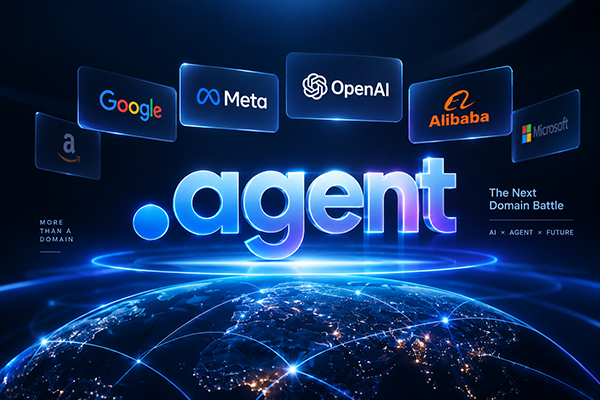
Why are tech giants vying for ".agent"?
The answer may lie in the fact that AI agents are fundamentally transforming how people interact with the internet.
Previously, users accessed services primarily through websites, search engines, and applications. With the evolution of AI agents, users are increasingly relying on these intelligent entities to perform tasks such as information retrieval, executing complex operations, navigating software, and even making business decisions.
An "agent" is no longer just a chatbot; it has the potential to become a new gateway connecting users to services and digital resources.
Against this backdrop, ".agent" carries a clear, industry-specific relevance.
For companies like Google, OpenAI, and Meta, applying for ".agent" is not just about securing a domain extension—it is a strategic move that could shape the future of their AI brand ecosystems, service access points, and digital identity frameworks.
Notably, the applicants are not limited to tech giants. Specialized domain industry players, such as Radix and XYZ.COM, have also entered the fray. This indicates that the value of ".agent" is recognized beyond the AI sector; domain registry operators also see significant potential in this market.
The $50 million figure is just a guess; the real focus should be on the auction rules.
This competition unfolds against a crucial backdrop: the 2026 round of new gTLDs introduced by ICANN features dispute-resolution rules that differ from those used in the previous round.
During the 2012 application round, applicants could resolve contention for the same string through mechanisms like private auctions. In the 2026 round, however, private auctions, joint ventures, and other arrangements aimed at resolving contention privately are strictly prohibited.
If contention cannot be resolved through established procedures—such as a "Community Priority Evaluation"—applicants must proceed to an official ICANN-conducted auction. Consequently, ICANN anticipates an increase in the number of official auctions during this round.
This means that if ".agent" ultimately goes to an official auction, the competitive process and the flow of funds will be governed by these new institutional arrangements.
However, the 13 applications do not necessarily mean that 13 companies will end up participating in an auction. The outcome could still be influenced by factors such as Community Priority Evaluations, changes in application status, or other procedural developments. Will ".agent" become a key digital gateway for the AI era?
From ".ai" to ".agent," the domain name industry is witnessing a shift—AI-related suffixes are moving beyond mere concepts into the realm of concrete commercial competition.
While ".ai" has already established itself as a widely recognized brand identifier for artificial intelligence companies and products, ".agent" points toward the burgeoning ecosystem of AI agents.
Of course, securing a top-level domain (TLD) does not guarantee dominance over the entire AI agent market. Whether it can generate genuine registration demand, user recognition, and a viable commercial ecosystem remains to be seen—only time will tell.
Yet, one thing is clear: when heavyweights like Google, OpenAI, Meta, and Alibaba all vie for the same suffix, ".agent" ceases to be just another routine domain application.
Who will ultimately secure ".agent"? And at what price will this competition conclude?
For the domain industry, this may well be one of the most significant developments to watch during the 2026 round of new gTLD applications.


 Contact Us