







contact@dn.com
+86 135-7488-8887
3814848

Please scan the code using WeChat
In the domain name market, it is not uncommon for companies to switch their domain names. However, as startups evolve from a phase of business growth to one of brand upgrading, the question of whether their existing non-.com domains can still meet their long-term development needs has become a topic worth noting.
Recently, three cases involving domain names have highlighted a similar trend.
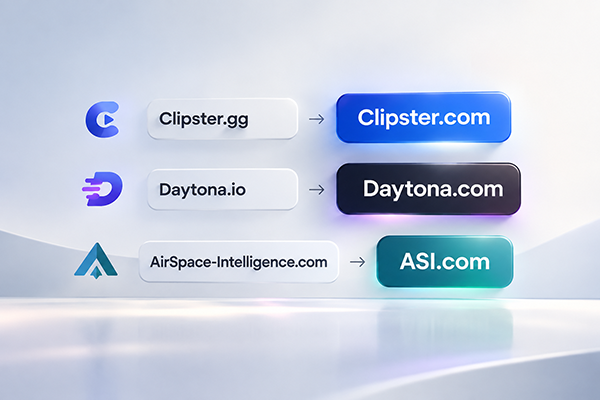
Clipster.gg upgraded to Clipster.com for $100,000—a deal that reportedly involved about 13 months of negotiations. For a startup with 150,000 users and an annual recurring revenue (ARR) of approximately $3.5 million, securing a .com domain that perfectly matches its brand name serves as both an upgrade to its digital assets and a strategic move in brand building.
Daytona.io acquired Daytona.com for $500,000. The developer infrastructure company subsequently closed a $60 million Series B funding round, reaching a valuation of $1 billion. As a business scales, a concise, unified brand gateway becomes increasingly important.
Another example is Air Space Intelligence, which transitioned from AirSpace-Intelligence.com to the more streamlined ASI.com. The company recently completed a $325 million Series C funding round, bringing its valuation to $3 billion. However, as the specific acquisition price for ASI.com has not been disclosed, it cannot be directly compared to the previous two transactions.
The .com domain remains a key choice for brand upgrades.
These three cases do not imply that every startup must use a .com domain. For early-stage ventures, extensions like .io, .ai, or .gg can be equally effective in helping a brand enter the market quickly.
Yet, as a company’s user base, revenue, and market influence grow, factors such as brand recognition, domain simplicity, and long-term brand management may prompt a re-evaluation of its domain assets.
At the same time, a multi-extension strategy is worth considering: should a company hold multiple versions—such as both .com and .ai—to protect its brand and cater to different business scenarios?
For domain investors, these cases highlight that a valuable domain must be more than just short; it must be aligned with genuine brand needs and business growth.
As a company matures, is a domain merely an access point, or is it a vital component of its brand assets? This is a trend worth watching closely in the future of the domain market.


 Contact Us