







contact@dn.com
+86 135-7488-8887
3814848

Please scan the code using WeChat
In 2023, cases of reverse domain name hijacking reached a historic high.
In rejected complaints, nearly one-fifth involved reverse domain name hijacking.
The chart shows the percentage of UDRP rejections and findings of reverse domain name hijacking by WIPO and forums, provided by John Berryhill.
The number of domain name hijacking cases filed under the Uniform Domain Name Dispute Resolution Policy (UDRP) in 2023 hit a record high. The number of maliciously filed cases (commonly known as reverse domain name hijacking) has also been increasing.
John Berryhill, an attorney, compiled data from the World Intellectual Property Organization (WIPO) and forums, the two largest UDRP providers, for last year and found 49 disputes resulting in findings of reverse domain name hijacking. (Others undoubtedly should have found them in the same way, but did not.)
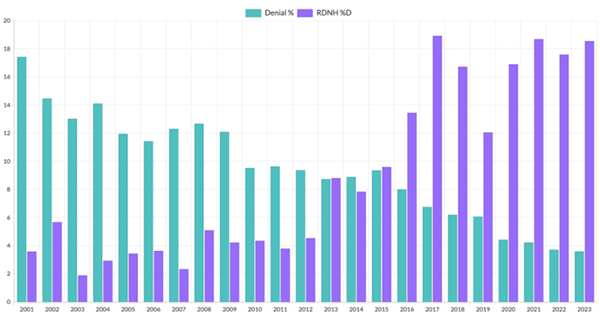
The proportion of cases favorable to domain registrants has been declining. Meanwhile, cases of reverse domain name hijacking are on the rise. This has resulted in nearly one-fifth of rejections being related to reverse domain name hijacking.
Several key points emerge.
First, the rate of case rejection is decreasing, which is a positive development. In a perfect world, all cases would win because cases are only filed in clear cases of domain name hijacking, which is precisely the problem UDRP aims to address.
Second, among the rejected cases, there are even more shocking cases being filed. I believe the increase in reverse domain name hijacking can also be attributed to better education of panelists, making them aware that frivolous UDRP applications impose unnecessary costs on domain owners.


 Contact Us