






contact@dn.com
+86 135-7488-8887
3814848

Please scan the code using WeChat
A notable policy shift has recently emerged within the domain name industry.
Verisign, a globally recognized domain registry, has adjusted its previously announced plan to discontinue support for ".name" third-level domains. The company has decided to maintain existing third-level domain registrations and their associated email-forwarding services. Consequently, tens of thousands of legacy domain records—which had faced the risk of mass deletion—have been granted a reprieve.
This development has not only brought relief to long-term users of ".name" third-level domains but has also prompted renewed industry-wide reflection on domain assets, user rights, and the operational responsibilities of domain registries.
I. From Planned Shutdown to Policy Reversal: What Happened?
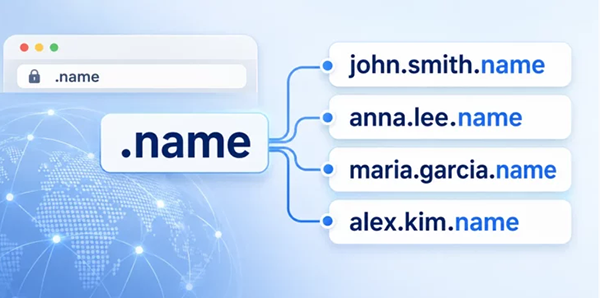
Launched in 2001, the .name top-level domain (TLD) featured the ability for users to register third-level domains—such as "firstname.lastname.name"—providing individuals with a unique online identity, complemented by an email forwarding service.
However, as internet usage habits evolved, this early model for personal domains gradually lost its appeal in the market.
In April 2026, Verisign submitted a request to ICANN to terminate the service, proposing to halt new registrations of .name third-level domains and discontinue existing records, along with their associated email forwarding services. ICANN approved this request on July 28.
According to previously disclosed data, approximately 22,000 third-level .name domain registrations were potentially affected.
This plan triggered strong opposition from users and the domain community. For many, these domains—in use for over a decade or even two—had become deeply integrated with personal email accounts, websites, and various online services. Deleting them would have entailed significant migration costs and potential risks.
Following persistent feedback from the community and requests for reconsideration, Verisign submitted a revised proposal to ICANN on November 5, opting to retain existing registrations and withdraw its previous termination request. On November 9, ICANN confirmed that the prior approval was no longer in effect.
II. The Core of the Policy Adjustment: Existing Registrations Retained, but New Registrations Likely to Cease
This adjustment does not mean that the .name third-level domain service has been fully restored to its original state.
According to the formal documentation submitted by Verisign, the new arrangement includes the following:
Existing third-level domains will be retained: Verisign will continue to support EPP (Extensible Provisioning Protocol) operations for existing registrations, allowing eligible, currently held domains to be renewed and used.
Email forwarding services will remain supported: Existing email forwarding registrations will also be preserved.
Conditions for continued service: The service remains contingent upon at least one ICANN-accredited registrar continuing to offer these services to users.
New registrations are still slated to end: Verisign intends to submit a revised application, continuing its pursuit to halt both new third-level domain registrations and the creation of new email forwarding addresses. Therefore, the core of this change is not a full-scale restoration of the .name third-level domain service, but rather a shift in policy direction: from a complete termination to a model that preserves existing registrations while restricting new ones.
For current users, this is a positive signal; for those hoping to register such domains, however, future opportunities remain uncertain.
III. Why does this policy reversal merit the attention of the domain industry?
First, it serves as another reminder that the value of a domain name is not determined solely by its market price or the number of registrations.
For a registry, a service may lose its commercial appeal due to declining usage or high maintenance costs. Yet, for long-term users, a domain name may embody their personal identity, email services, websites, and digital connections built up over many years.
In the case of some early domain systems, in particular, their historical significance and the degree of user reliance are difficult to quantify through commercial data alone.
Second, this incident highlights the effectiveness of the multi-stakeholder governance model within the domain industry.
As the registry, Verisign is responsible for operating and managing the relevant domain services, while ICANN acts as a coordinator—balancing the operational needs of the registry, the security and stability of the DNS, and established policy procedures.
The fact that users were able to prompt a policy re-evaluation—through formal feedback, requests for reconsideration, and community discussion—ultimately leading to a solution that preserves existing registrations, demonstrates that domain policy is not dictated solely by the unilateral commercial considerations of a registry.
IV. The long-term value of domain assets: Lessons from the .name case
For the domain industry, this incident offers a significant point for reflection:
Domain names are not merely digital assets for trading or investment; they also serve as enduring identifiers within the internet’s infrastructure.
Even if a domain’s commercial value is limited, as long as it continues to fulfill the practical needs of its users, it may possess a utility value that is not easily replaced.
As the domain industry continues to evolve, the challenge of balancing commercial efficiency with the rights of existing users—especially when registries adjust their product structures or seek to optimize operational costs—will remain an issue worthy of ongoing attention.


 Contact Us