





contact@dn.com
+86 135-7488-8887
3814848

Please scan the code using WeChat
Recently, a seemingly ordinary domain name—a16z.vc—has sparked discussion within the industry. The reason is simple: visiting the site reveals no complex content, just a message addressed directly to a16z—"hello folks @a16z if you're interested in this domain, hit me up!"—along with the X account of the domain's owner, Evan Frawley. He is publicly signaling to a16z: if you are interested, feel free to get in touch.

According to public records, a16z.vc was registered on March 5, 2019, whereas Andreessen Horowitz’s primary domain, a16z.com, dates back to January 26, 2009—coinciding closely with the company's founding. In other words, a16z.com predates a16z.vc by a full decade. Evan Frawley stated that he registered the domain about seven years ago as a young entrepreneur without any malicious intent, and he is willing to transfer it if a16z is interested. Based on current information, while he holds the domain and has expressed a willingness to sell, the situation does not yet meet the criteria to be definitively classified as "malicious cybersquatting."
Why specifically .vc? This is perhaps the aspect of the story that most interests the domain community. While .vc is the country-code top-level domain (ccTLD) for Saint Vincent and the Grenadines, the letter combination happens to correspond to the abbreviation for "Venture Capital," giving it a unique semantic resonance within the startup and investment sectors. Domains such as tiny.vc, hack.vc, and 2048.vc have previously been utilized by investment firms or related projects. Combining "a16z" with ".vc" is a very natural fit; had a16z sought a short domain strongly associated with venture capital back in the day, a16z.vc would have been a perfect semantic match. This explains why its recent appearance has rapidly captured the attention of both the domain and venture capital communities.
Some argue that since a16z already owns a16z.com, anyone else registering a16z.vc is engaging in "cybersquatting." However, under Domain Name System (DNS) rules, different top-level domains operate as independent registration systems; owning a16z.com does not automatically grant rights to a16z.vc, a16z.ai, a16z.io, or other extensions. For a brand to secure these domains, it typically must register them in advance, hold them defensively, or acquire them on the secondary market. Determining whether an action constitutes trademark infringement or malicious registration requires a comprehensive assessment involving registration timing, intent, usage, trademark rights, and dispute resolution policies. The act of registration, the manner of use, and any subsequent sale are three distinct issues. So, will a16z buy it back? From a purely brand management perspective, a16z already owns the core domain a16z.com; a16z.vc is not a critical asset without which operations would be impossible. On the other hand, however, it offers an exceptionally strong brand fit. Acquiring it would make business sense if a16z wished to protect a brand keyword, prevent long-term third-party ownership, or utilize it for a specific investment project or sub-brand. This presents a classic domain transaction scenario: the holder perceives scarcity value, while the brand must determine whether that scarcity justifies the cost.
How much is a16z.vc worth? From a domain investment standpoint, its advantages are clear: it is short, with a core brand element of only three characters; a16z is a globally renowned VC brand, and the .vc extension is highly relevant to "Venture Capital," making the combination virtually self-explanatory. Ultimately, however, domain value is determined by market demand—this is especially true for branded domains, which might be viewed merely as a domain by an ordinary buyer but as a strategic asset by a specific brand. The real question is not "how much is this domain worth," but rather "how much is a16z willing to pay for it"—and the two figures could be vastly different.
The domain industry has seen plenty of similar cases. In September 2026, Uniswap founder Hayden Adams shared a story: the original holder of Uniswap.com quoted a seven-figure price, which Uniswap declined at the time. Later, Sam Bankman-Fried purchased the domain and pointed it to a Uniswap fork; Adams noted that Uniswap eventually regained the domain through legal channels without paying the initial seven-figure asking price. While this case differs from the a16z.vc situation, it illustrates a key point: the value of a branded domain sometimes stems not from traffic, but from the brand's strategic need for that digital asset.
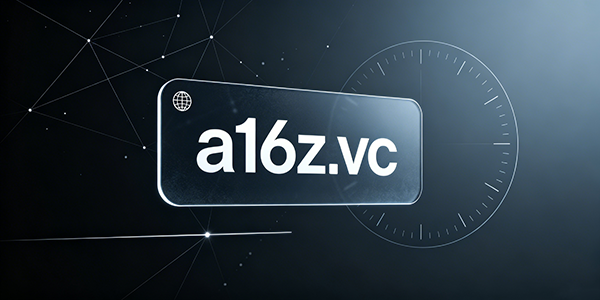
The most noteworthy aspect of this story may not be whether the domain ultimately fetches a high price, but rather why a domain registered in 2019 has suddenly regained market attention seven years later. The answer lies in the logic of long-term domain value: a website’s lack of traffic today does not mean the domain lacks future value. If a string is sufficiently short and memorable, highly relevant to a rapidly growing industry, closely aligned with a well-known brand, and carries a clear semantic meaning via its extension, it can retain latent value over a long period. The domain a16z.vc happens to meet several of these criteria.
For domain investors, value sometimes stems from the "present" and sometimes from the "future." When a16z.vc was registered in 2019, the rationale behind its value differed from today's; however, as the a16z brand’s influence expanded and the semantic association of ".vc" with the venture capital sector solidified, the commercial significance of this combination became increasingly apparent. Of course, this does not imply that one should simply register any domain containing a brand name. With growing emphasis on brand protection and domain disputes, investors must pay close attention to factors such as registration timing, trademark status, registration intent, actual usage, the risk of confusion, legitimate commercial interests, and legal issues surrounding potential future sales. There is a boundary between domain investment and trademark speculation that requires careful discernment.


 Contact Us