






contact@dn.com
+86 135-7488-8887
3814848

Please scan the code using WeChat
Following the closure of the application window for the 2026 round of ICANN’s new generic Top-Level Domain (gTLD) program, the domain industry is witnessing a new "race for top-level domains."
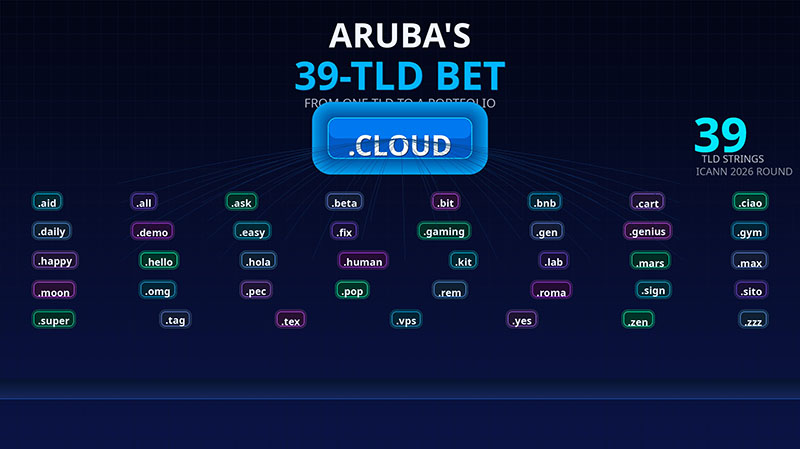
Recently, the Italian internet service company Aruba has drawn significant industry attention. Aruba—the operator of the .cloud domain—applied for 39 TLD strings in this round of the ICANN program, spanning sectors such as technology, business, lifestyle, and entertainment, as well as general-purpose terms. This move signals that Aruba’s ambitions extend beyond merely operating a successful TLD; the company aims to build a comprehensive portfolio of TLD assets.
From .cloud to 39 TLDs
Aruba’s most iconic TLD to date has undoubtedly been .cloud. Having applied during the previous round of new top-level domain expansion in 2012, Aruba ultimately secured the rights to .cloud. Today, .cloud boasts over 500,000 registrations, establishing itself as one of the more substantial new gTLDs. However, for the upcoming 2026 application round, Aruba has significantly expanded its strategic scope.
The 39 strings it has announced include:
.aid, .all, .ask, .beta, .bit, .bnb, .cart, .ciao, .daily, .demo, .easy, .fix, .gaming, .gen, .genius, .gym, .happy, .hello, .hola, .human, .kit, .lab, .mars, .max, .moon, .omg, .pec, .pop, .rem, .roma, .sign, .sito, .super, .tag, .tex, .vps, .yes, .zen, .zzz.
These strings demonstrate that Aruba’s strategy is not confined to any single vertical industry.
For example:
.gaming / .gym / .vps → Gaming, fitness, and infrastructure
.lab / .genius / .human → Technology, innovation, and AI-related contexts
.cart / .daily / .demo → Commerce, e-commerce, and internet applications
.hello / .hola / .ciao / .yes → Everyday language and social expressions
.max / .super / .zen / .happy → Branding, lifestyle, and consumer markets
This approach resembles the construction of a TLD portfolio designed to reach diverse user demographics.
Competition for New gTLDs Is Intensifying
Aruba is not the only company pursuing a large-scale strategy.
Among this year’s applicants, Namecheap’s Starlight Registry has applied for 40 TLDs; ShortDot has also applied for 40; Radix has applied for 46; and Link Freedom Group has disclosed over 300 primary and alternative strings.
This highlights a clear trend: competition in the new gTLD space is shifting from the question of "who can secure a desirable suffix" to "who can build a TLD portfolio with scale, clear positioning, and commercial operational capabilities." This actually bears similarities to the domain name investment market. In the past, investors might have focused primarily on premium single words, short character strings, or high-quality .com domains. However, at the TLD level, an increasing number of participants are beginning to consider: What is the intrinsic value of a specific suffix? And what is the combined value of a set of related suffixes?
What does this mean for the domain industry?
From a domain investment perspective, Aruba’s 39 applications are particularly noteworthy. Many of the requested strings are keywords highly familiar to domain investors—such as .bit, .lab, .gaming, .human, .max, .super, and .zen. If these TLDs successfully enter the market, they could foster new ecosystems for second-level domains and potentially influence how companies approach branding and naming in the future.
More importantly, with the continuous emergence of new sectors—such as AI, Web3, robotics, gaming, and digital infrastructure—the combination of "keywords + new suffixes" is becoming a branding strategy worth watching closely. Of course, applying for a TLD is not the same as securing it. Some strings may face competitive applications, evaluations, or subsequent procedural hurdles; therefore, the most accurate description at this stage is that Aruba has "applied for 39 TLD strings" rather than already possessing 39 new top-level domains.
A signal worth noting
Aruba’s move from .cloud to applying for 39 TLDs reflects a significant shift occurring in the new gTLD market:
Top-level domains are evolving from mere "domain suffixes" into portfolios of digital assets capable of scalable operation.
If a large number of new gTLDs from this round successfully enter the market, the future domain industry may involve more than just competing for premium second-level domains.
Success in the next phase of competition may hinge on who owns the best TLDs, who possesses the strongest keyword ecosystems, and who can effectively manage multiple TLDs as a cohesive digital asset portfolio.


 Contact Us