
contact@dn.com
+86 135-7488-8887
3814848

Please scan the code using WeChat
A platform with over a billion users is applying for its own top-level domain.
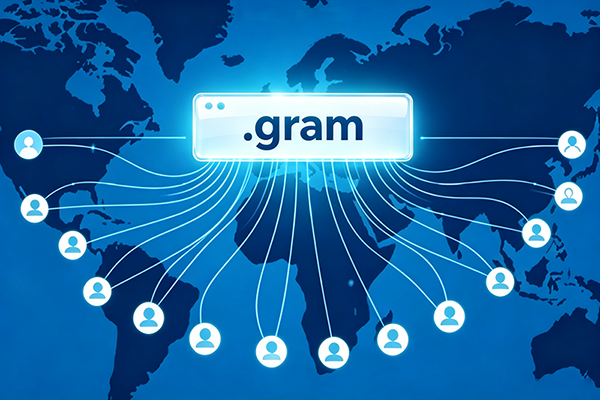
On August 18th, Telegram founder Pavel Durov publicly announced that Telegram had applied to ICANN for the .gram domain zone. Durov stated that if the application is approved by ICANN, Telegram users may be able to obtain their own subdomains in the future, such as yourname.gram. Simultaneously, users will be able to host interactive websites through Telegram, and even create their own web pages with just a prompt.
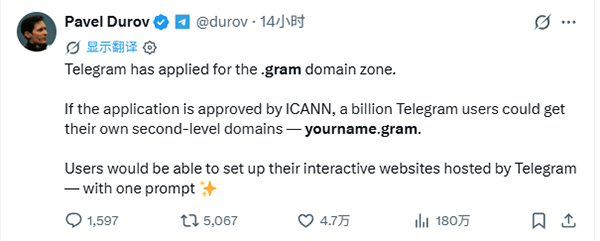
This news quickly attracted attention in the domain name industry. This is because it's not just "Telegram applying for a new top-level domain," but rather a platform with over 1 billion users attempting to integrate social identities, domain names, and website entry points into a single ecosystem.
01 Why is Telegram applying for .gram?
From Telegram's product development perspective, applying for .gram is not an isolated action.
In recent years, Telegram has gradually evolved from a simple instant messaging tool into a comprehensive platform, covering channels, bots, mini apps, payments, and various third-party applications.
If .gram is approved in the future, Telegram can further extend users' identities on the platform into the internet domain name system.
For example, a Telegram username like @alice might correspond to alice.gram in the future. This means that a Telegram username is no longer just a social account, but could also become a digital identity entry point. For ordinary users, the biggest attraction of this model is its simplicity. Traditional websites often require registering domain names, purchasing servers, configuring DNS, and building a website.
Telegram envisions a model where a username + a .gram address + a prompt word = an accessible website. This effectively lowers the barrier to entry for personal website creation.
02 However, there's a crucial distinction: .gram is not the same as a regular domain name.
This is especially important for the domain name industry.
If Telegram ultimately acquires and operates .gram, the username.gram that users receive is not entirely the same as a traditionally registered .com or .net domain.
According to currently available information, Telegram describes itself as a platform providing users with subdomain and website services. In other words, the future username.gram is more likely to be a platform-managed address within the Telegram ecosystem, rather than an independent domain asset that users can freely transfer, trade, and choose registrar for. This means that users possess a digital identity portal, but not necessarily an independent domain asset in the traditional sense. This is crucial for both domain investors and end-users.
03 Telegram's entry brings renewed attention to "brand TLDs"
In the past, new gTLDs were largely seen by the domain name industry as a new suffix market. However, Telegram's approach may offer another perspective: top-level domains don't necessarily have to be primarily a "domain selling" business; they can also become the infrastructure of a large internet platform. If Telegram ultimately succeeds in operating .gram, then what it's truly interested in may not be the second-level domain registration fee, but rather:
a user identity system, website entry point, unified branding, AI-powered website building, mini apps, digital services, and platform ecosystem. All of these can be connected around a single top-level domain. This is also the most noteworthy aspect of this event for the domain name industry.
04 This is also a landmark case in the wave of new gTLDs in 2026.
Telegram's application came just after the ICANN 2026 new gTLD application window closed.
Official ICANN data shows that this round of applications closed at 23:59 UTC on August 12th, receiving over 1,600 new gTLD applications. ICANN expects to announce the applications that passed administrative review and the relevant strings within nine weeks of the application window closing.
This means that .gram is just one application in this wave of new gTLDs, but the applicant behind it—Telegram—possesses extremely strong global brand influence and a massive user base.
Previously, it was not uncommon for internet giants to apply for brand top-level domains.
However, if Telegram truly connects .gram with its billion-user system, it could become a significant case of new gTLDs evolving from "brand identifiers" to "user identity infrastructure."
05 What does this mean for the domain investment market?
In the short term, .gram cannot yet be considered a new top-level domain (TLD) that is open for registration.
Application ≠ Approval.
Even if the application is successful, it still needs to go through ICANN's evaluation, dispute resolution, contract and technical operation processes. Therefore, it is inappropriate to consider .gram as a new investment suffix at this time.
However, in the long term, this event releases at least three noteworthy signals.
First, platform giants are redefining the value of "domain names."
In the past, a domain name was primarily a website address. Now, domain names are gradually becoming a comprehensive carrier of: brand + identity + social media account + website + AI entry point. Telegram's .gram concept is a typical example of this trend.
Second, platforms with a huge user base have a very strong ability to promote new TLDs.
A typical new gTLD requires a lot of money and time to educate users after its launch. But Telegram is different. If it directly connects .gram with the existing username system in the future, it naturally possesses a huge potential user pool. This is why "platform-based TLDs" deserve the continued attention of the domain name industry.
Third, traditional domain names and platform-based digital identities may coexist for a long time.
.gram will not necessarily replace .com. On the contrary, the two may cater to different needs. .com emphasizes openness, independence, portability, and long-term brand assets; while platform-based domains like .gram emphasize ecosystem, identity, and service entry points. In the future, users may simultaneously possess three different forms of digital assets: brand .com + social identity .gram + AI website entry point.
06 Will .gram become the next phenomenal new gTLD?
It's too early to draw conclusions. After all, .gram is still in the application stage, and whether it will ultimately receive ICANN approval, and how Telegram will ultimately design its second-level domain system, remains to be seen. But what is certain is that Telegram is attempting to transform "usernames" into "internet identities." If a future platform with a billion users allows them to directly own an accessible, interactive, and even AI-generated website through yourname.gram, it could change many people's understanding of "domain names."
In the past, we bought domain names to build websites. In the future, platforms may directly transform user identities into domain names, domain names into websites, and websites into service portals. This may be the biggest lesson Telegram's application for .gram has for the domain name industry.
As for whether .gram can become the next phenomenal new gTLD,
the answer may only be revealed after it actually launches.


 Contact Us