



contact@dn.com
+86 135-7488-8887
3814848

Please scan the code using WeChat
On July 9, 2026, the four-letter .com domain name Amos.com was sold for $365,000. This is another notable transaction in the domain name market since July, continuing the trend of strong performance for short-word .com domain names this year.

About the name "Amos"
Amos originates from the Hebrew word עָמוֹס, literally meaning "to carry" or "carried by God."
In Western culture, Amos has deep cultural roots:
Biblical Prophet: Amos is one of the twelve minor prophets in the Old Testament, author of the Book of Amos, which focuses on social justice and righteousness and enjoys widespread recognition in Christian and Jewish traditions.
Classic Name: In English-speaking countries (the United States, the United Kingdom, Canada, Australia, etc.), Amos has been used as a male name for centuries, with high recognizability, simple pronunciation, and intuitive spelling.
Cultural Symbol: Amos also appears in numerous literary and musical works. For example, famous singer Tori Amos and blues legend Amos Milburn imbue the name with rich cultural connotations.
Key Attributes: 4 letters, globally recognized, profound meaning, and strong cultural penetration.
Amos.com is suitable for companies across various sectors to build brand websites, offering broad commercial application potential: In the healthcare field, it can be compared to the high-priced Derm.com, suitable for clinics and health device brands; the legal and financial consulting industries leverage the personal name attribute to create a stable and trustworthy professional image; AI technology startups can use the short domain name to build a lightweight digital brand; based on its inherent biblical cultural background, it is also suitable for education and charitable foundations; at the same time, high-end consumer brands such as whiskey and specialty coffee can also rely on short personal name domain names to create differentiated brand recognition.
Market Analysis: The Value Logic of Four-Letter Personal Name .com Domains
1. Continued Premium for Short Domain Names
Referring to recent transaction data from June to the present, the 2026 domain name trading market continues the underlying logic of "the shorter, the more expensive":
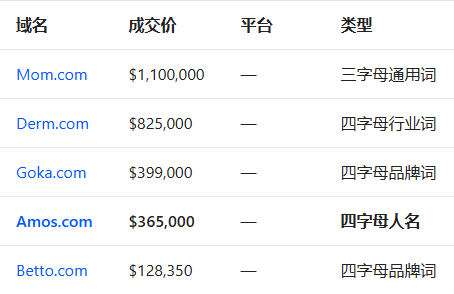
The sale price of Amos.com at $365,000 places it in the mid-to-high range of four-letter .com domains, roughly on par with Goka.com ($399,000).
2. The Unique Value of Personal Name Domains
Unlike industry-specific domains (such as Derm.com), the value of personal name domains comes from brand flexibility—they are not tied to a specific industry, allowing buyers to freely define their business direction as a "surname brand."
Similar examples include:
Classic personal name domains like James.com have long been held by end-users.
Tens of thousands of people worldwide with the surname "Amos" and entrepreneurs named Amos are potential end-users.
3. Absolute Scarcity on the Supply Side
There is only one Amos.com globally. There are only about 467,000 four-letter .com domains in total, and meaningful, globally recognized English personal name domains are even rarer. This scarcity drives up the price floor of high-quality four-letter .com domains.
Industry Observation
The domain name market in 2026 is showing a clear stratification:
Top-tier: Core industry keywords .com (AI.com $70 million, Mom.com $1.1 million)
High-end: Short-letter brand keywords .com (Derm.com $825,000, Amos.com $365,000)
Growth stage: AI-related .ai domains (Deep.ai $140,000, Ai.exchange $100,000)
The sale of Amos.com once again proves that short-letter .com domains with cultural connotations, even if not directly related to an industry, can still gain high recognition in the end market. It doesn't need to "explain what industry it is"—it is a brand in itself.


 Contact Us