






contact@dn.com
+86 135-7488-8887
3814848

Please scan the code using WeChat
At the start of 2026, the global artificial intelligence field will witness a major capital event: OpenAI is about to complete a new round of financing of $100 billion. This figure breaks the record for financing in the AI industry and will become the largest single financing in the field to date. It will also make the global market focus on the development potential and industry landscape of the AI track once again.
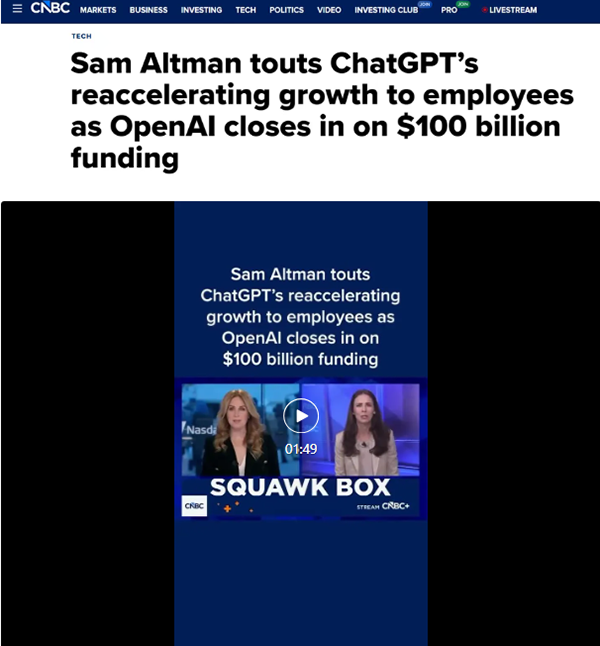
It is reported that this $100 billion financing round is planned to be carried out in two phases. The first phase will introduce tech giants such as Microsoft and Nvidia, with Amazon also in talks, planning to invest up to $50 billion. The second phase will see additional investment from investors such as SoftBank. SoftBank previously invested $30 billion in OpenAI in March 2025 and plans to invest another $30 billion this time. The specific details of the financing are still under negotiation and may be subject to adjustment. The entry of these giants reflects the dual recognition of OpenAI's commercial value and technological strength. The outstanding performance of its core product, ChatGPT, is an important support. ChatGPT currently has over 800 million weekly active users, with a monthly growth rate returning to over 10%. The accelerated growth on a large scale demonstrates the product's market stickiness. At the same time, its code tools business for developers grew by 50% in one week, and the commercial potential of its product matrix continues to be released, providing a solid fundamental support for capital injection.
This $100 billion funding round not only strengthens OpenAI's own development but also reflects the current capital logic and development characteristics of the global AI industry. From a capital perspective, this funding is not simply a financial investment, but rather a strategic move by tech giants to position themselves within the AI industry chain. The entry of companies like Microsoft, Nvidia, and Amazon essentially creates a synergistic model of "investment + industry cooperation." By injecting capital, they secure collaborative resources with OpenAI in areas such as models, computing power, and applications, thereby consolidating their competitive advantages in cloud services, chips, and AI applications. This deep integration has become a typical approach for tech giants in the AI field.
From an industry development perspective, OpenAI's $100 billion funding surge also reflects that the AI industry is currently in a critical stage of "simultaneous technological breakthroughs and commercialization." On the one hand, technological competition in the AI industry is becoming increasingly fierce. OpenAI previously declared a red alert to optimize ChatGPT, suspending non-core projects to concentrate resources on intensive development. Even with its large user base, it still faces market share pressure from companies like Google and Anthropic. This round of financing will further support its investment in model development and computing power, continuously building technological barriers. On the other hand, the commercialization of AI is accelerating. OpenAI recently launched advertising testing in ChatGPT, marking a new attempt at commercialization. From an industry-wide perspective, both enterprise-level services based on large models and AI applications in vertical fields are moving from "technology verification" to "commercial monetization," but currently still face challenges such as insufficient application scenarios and long return-on-investment cycles.
However, behind the capital frenzy, the development of the global AI industry also harbors challenges and considerations. Currently, leading technology companies are experiencing explosive growth in their AI investments. The heavy asset and long-cycle investment characteristics directly squeeze the short-term profit margins of some companies, even leading to "debt-driven investment," and the risk of an industry valuation bubble is also attracting market attention. Meanwhile, AI technology development also faces challenges such as data bottlenecks and the limitations of pre-training paradigms. Simply "parameter stacking" and "computing power races" are no longer sufficient to achieve leapfrog technological advancements. How to achieve efficient technological breakthroughs and move AI from the "laboratory" to broader industrial applications has become a core issue that the entire industry needs to address.
OpenAI's recent $100 billion funding round undoubtedly sets a tone of "high investment and deep strategic planning" for the global AI industry in 2026. For the entire industry, this funding affirms the commercial value of AI technology and injects capital momentum into industry development, promoting collaborative development across the industry chain. However, the industry also needs to remain rational amidst the capital frenzy, balancing technological research and development with commercialization, and long-term strategic planning with short-term profitability. In the future, with continued capital injection and technological breakthroughs, the competitive landscape of the AI industry will be further restructured, and those companies that can achieve technological breakthroughs and find efficient commercialization paths will become the core winners in the industry's development.


 Contact Us