




contact@dn.com
+86 135-7488-8887
3814848

Please scan the code using WeChat
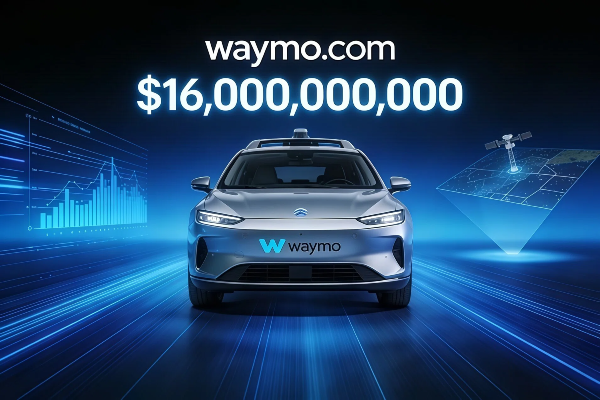
Recently, Waymo, the self-driving car giant under Alphabet, completed a massive $16 billion funding round, boosting its valuation to $126 billion and making it the absolute benchmark in the global autonomous driving field. The core domain name supporting this tech giant's brand image, waymo.com, has an acquisition story and strategic layout that serves as a textbook example of domain name strategy for tech companies, providing profound insights for domain investors and end-user companies.
I. Domain Origin: Registered in 2000, formerly owned by a regular company
The domain name waymo.com dates back to April 2000, nearly a decade before the launch of Google's self-driving car project. Prior to 2016, the domain was not held by Google, but by a regular company with the same name in Colorado, USA. At that time, waymo.com existed only as a regular corporate domain, unrelated to the high-tech field, and did not attract widespread attention. This "domain name preceding brand" situation laid the groundwork for Google's subsequent acquisition and also confirms the long-term value retention of high-quality short domain names.
II. Key Milestone: Google's Covert Acquisition, Connecting to the Brand's Independence
In December 2016, Google's parent company, Alphabet, made a major strategic decision—spinning its self-driving car project, which had been under development for seven years, from Google X Labs to establish an independent subsidiary, "Waymo," meaning "A new way forward in mobility." Just one day before Waymo officially announced its founding (December 13th), the WHOIS information for waymo.com was quietly updated, showing Google as the new owner. This precise timing sparked heated discussions within the industry.
Industry insiders widely speculate that Google, to avoid exorbitant demands from the domain owner, deliberately conducted a covert acquisition through professional domain management companies like DNStination Inc., without disclosing the specific transaction amount. This move is considered a classic strategy for giants acquiring domains: securing core assets before brand exposure avoids cost spikes due to identity leaks and ensures a seamless transition between brand launch and domain activation. Initially, while waymo.com was not publicly accessible, it appeared in links on Waymo's official Twitter account, marking its initial debut as a brand domain.
III. Comprehensive Domain Strategy: From Core Domains to Matrix Protection, Building a Brand Moat
Google's domain strategy for Waymo has not stopped at waymo.com. Following the acquisition of its core domain, Google swiftly implemented comprehensive brand domain protection: on one hand, it acquired mainstream domain extensions such as waymo.net, .co, .tv, and .org, unifying them under the "dns-admin@google.com" management system to eliminate brand confusion; on the other hand, it registered 19 second-level country code domains (ccTLDs) for different national and regional markets, including waymo.co.uk, .com.mx, and .de, paving the way for global business expansion.
As Waymo's commercialization accelerated, its domain portfolio became even more refined. In October 2018, after announcing that its autonomous driving service would begin charging fees, Google registered a batch of business-scenario-related domains: waymophoenix.com corresponding to the Phoenix testing project, waymoearlyrider.com for early adopter programs, and waymofleetsupport.com for fleet operations, covering multiple dimensions including technology development, user services, and regional operations. To date, Google has reserved nearly 50 related domain names for Waymo, covering traditional suffixes, new top-level domains (.car/.auto/.cab, etc.), and business-derived domains, forming a comprehensive brand domain name matrix.
IV. Domain Value: The Cornerstone of a Brand Behind a Trillion-Dollar Valuation
Today, waymo.com has become a core component of Waymo's brand assets, serving as a crucial entry point for showcasing its global business, connecting with users, and negotiating business partnerships. From Google's covert acquisition to Waymo becoming an industry giant with a valuation of $126 billion, the value of waymo.com has long transcended the "digital address" itself—it is not only a core guarantee of brand consistency and an important carrier of user trust, but also a strategic fulcrum for the tech giant's future strategy.
This case offers multiple insights for the industry: For end-user companies, securing core domain names in advance is a prerequisite for brand launch, especially in trust-intensive sectors like high-tech and finance, where short and precise .com domains can significantly reduce brand communication costs; for domain investors, short character domains with industry relevance and no obvious semantic limitations are often more likely to attract industry giants and possess long-term appreciation potential; and Google's comprehensive domain strategy further demonstrates that brand domain protection is not a single action, but a systematic project spanning the entire lifecycle of a company's development.
As Waymo continues its efforts in the field of autonomous driving, the brand empowerment value of waymo.com will become even more prominent.


 Contact Us