





contact@dn.com
+86 135-7488-8887
3814848

Please scan the code using WeChat
In the domain name trading market, there are both high-profile transactions like the recent sale of kkbet.com ($141,000) and potential.ai ($37,000), which have ignited the industry, and numerous little-known domain name auctions—which quietly go live, fail to sell, or even attract only a handful of viewers throughout the entire process. This stark contrast is not accidental, but rather the result of multiple factors, including information barriers, domain name characteristics, and promotional strategies.
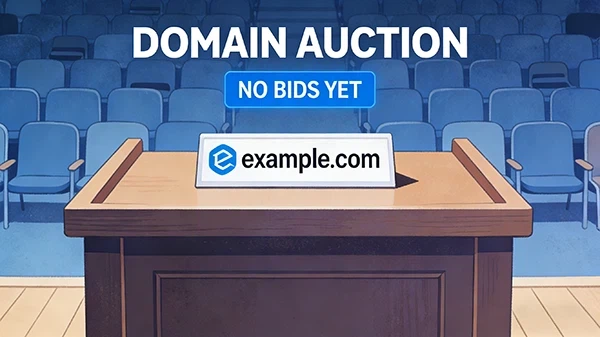
I. Lack of Information Transparency: A Dual Obstacle of Privacy Protection and Fragmented Channels
The "hidden" nature of domain auctions stems primarily from inherent barriers to information dissemination.
**Privacy Protection Limits Dissemination:** To avoid harassment, most domain registrations enable privacy protection services, hiding the true owner's information. This prevents auction information from directly reaching potential buyers, forcing reliance on limited platform exposure channels, naturally hindering the generation of buzz.
**Uneven Platform Traffic Distribution:** Mainstream domain trading platforms focus on top-tier, high-quality domains (short characters, strong semantics, popular suffixes), allocating core traffic to high-value targets, while mid- and long-tail domains often only receive basic display positions, significantly reducing exposure.
**Fragmented Channels Distract Attention:** Domain auctions are distributed across dozens of platforms globally, from Sedo and GoDaddy to domestic platforms like Alibaba Cloud and Leyu, lacking a unified information aggregation portal. Investors struggle to access all channels, and auctions scattered across niche platforms are naturally overlooked.
II. Domain Value: Lack of "Memorable Features" Makes it Difficult to Attract Attention
The core characteristics of a domain directly determine the upper limit of its auction's attractiveness.
Semantic ambiguity or limited application scenarios: Unlike the precise semantic meaning of potential.ai's "unleashing AI potential," many auction domain names are either meaningless character combinations or only suitable for extremely narrow vertical scenarios, failing to attract the interest of investors and end-user companies.
Lack of advantages in suffixes and character structure: Domain names with non-mainstream suffixes such as .com or .ai, or those that are too long or complex in spelling, inherently present a barrier to dissemination. Even if they enter the auction market, they struggle to break through the "niche" label.
Hidden risks in historical records: Some auction domain names have been involved in illegal uses, penalized by search engines, or have records of property disputes. These "problematic domain names," even at low prices, will be avoided by the market due to a lack of trust.
III. Lack of promotional strategies: Passive waiting rather than proactive marketing
Many domain name auctions fall into the predicament of "listing and then sitting still," the core issue being a lack of proactive promotion awareness.
Sellers rely on organic platform traffic: Most holders passively wait after listing their domain names, failing to conduct targeted promotion based on the domain's characteristics, such as targeted recommendations to companies in vertical industries, or disseminating auction information on domain forums and social media platforms.
Lack of compelling value narratives: High-priced domains are often accompanied by clear value narratives, such as BuzzAldrin.com being associated with the aerospace trend and mal.ai being linked to AI-driven financial financing. Auctions with no bidders, however, often only list the domain name and starting price, failing to convey their application potential and investment value.
Unreasonable pricing strategies: Starting prices that are too high, exceeding market expectations, or starting at a low price without tiered bidding, deter potential buyers, ultimately leading to a "no bids" situation.
IV. Market supply and demand mismatch: Niche demands struggle to reach a consensus
The popularity of domain auctions is essentially a precise match between market supply and demand.
Limited demand in vertical sectors: Some auctioned domains focus on niche industries (such as niche tools or regional services), with a small potential buyer base, making it difficult to create a competitive bidding atmosphere and thus failing to attract widespread attention.
Investment preferences are concentrated: Current market funds favor popular targets such as short-character .com domains and AI/Web3-related .ai domains, while attention to traditional industries, long-character domains, or new top-level domains continues to decline, making these domain auctions a "niche game."
Information asymmetry leads to a lack of trust: Buyers cannot quickly verify key information such as domain ownership and outstanding fees. Even if they see auction information, they may not participate due to risk concerns, further reducing auction activity.
V. Industry Ecosystem Characteristics: Private Domain Transactions Divert Public Auctions
The "private domain attribute" of domain transactions is also diverting attention from public auctions.
Priority domains are prioritized for private domain circulation: Truly premium domains are often traded through private negotiations and brokerage, without needing to enter the public auction process. Domains entering auctions are mostly those with weak liquidity or questionable value, naturally failing to attract attention.
Investor-centric dissemination: Experienced domain investors obtain high-quality auction information through exclusive communities and offline exchanges. Ordinary investors have difficulty accessing these "internal channels," resulting in many potentially valuable auctions being confined to a small circle. How to Make Domain Auctions "Seen"? Core Breakthrough Strategies
For domain holders, the key to increasing auction visibility lies in breaking down information barriers and strengthening value transmission:
Choose mainstream trading platforms with concentrated traffic, cooperate with the platform to verify domain information, and reduce buyer trust costs;
Pack the domain's value story, clearly defining its suitability for specific industries, application scenarios, and investment potential, rather than simply displaying characters;
Disseminate auction information through multiple channels, reaching potential buyers through domain forums, industry communities, and social media;
Establish reasonable pricing and bidding rules that reflect the domain's value while attracting more buyers to participate in the bidding.
As the core bridge connecting buyers and sellers, domain trading platforms are using technologies such as intelligent matching and precise recommendations to reduce "hidden auctions" caused by information asymmetry. In the future, with increased market transparency and improved promotion mechanisms, more domains with potential value are expected to emerge from obscurity and achieve value reassessment.
If you have a high-quality domain to auction or want to obtain first-hand information on high-potential auction items, contact the platform's dedicated consultant for customized promotion plans and precise matching services, ensuring your digital assets are no longer "unnoticed"!


 Contact Us