







contact@dn.com
+86 135-7488-8887
3814848

Please scan the code using WeChat
With the outbreak of the Russia-Ukraine conflict, not only has the international situation been greatly affected, but the flames of this war have also spread to the realm of the internet. According to reports, the Russian government has recently decided to switch all internet services to the .ru Russian national top-level domain (TLD) by no later than March 11th, abandoning overseas hosting and traffic.
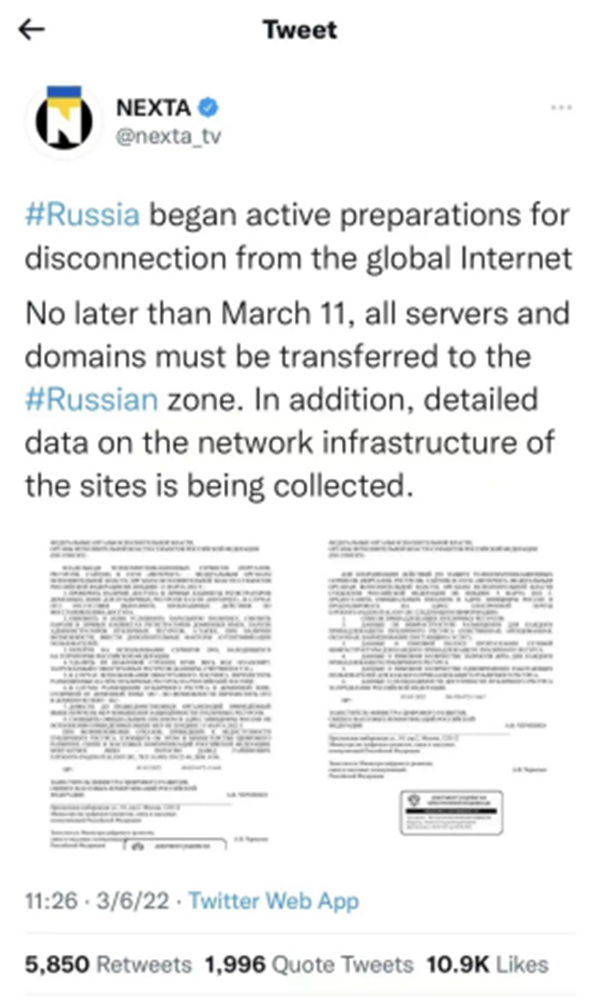
Meanwhile, a massive hacker group called "Anonymous" has been continuously attacking Russian government websites, and a Distributed Denial of Service (DDoS) attack has severely impacted Russia's .ru top-level domain, with the goal of fundamentally disrupting access to all URLs ending in .ru.

In the digital age, domain names have become extremely important digital assets, impacting not only internet security but also national information security. Russia's current internet crisis may also find a solution through domain names.
The operational model of globally renowned second-level domain registrar CentralNic could offer a new approach to alleviate the Russian crisis. The company specializes in selling second-level domains under domain names it holds, including us.com, no.com, br.com, cn.com, eu.com, uk.com, se.com, ru.com, ar.com, and other two-letter .com domains.
It's easy to see that these two-letter domains held by CentralNic can represent countries, such as US.com for the United States, BR.com for Brazil, DE.com for Germany, and so on. Registering such domains has regional characteristics, high recognizability, and, most importantly, they hold the national domain name "RU.com."
This provides a new option for local businesses in Russia and foreign enterprises with local operations. If access to the Russian .ru domain is cut off, these businesses can choose to use the second-level domain .ru.com.
This not only highlights Russia's regional characteristics and strengthens brand identity but also ensures smooth user access without causing confusion or concern.
Examining CentralNic's sales model, it's worth exploring and developing this direction for certain two-letter domains with rich meaning and inherent traffic. For instance, two-letter domains like KR.com and JP.com represent the abbreviated letters for "Korea" and "Japan," respectively. These domains are highly recognizable, representing the entire national image and possessing a natural advantage.

If KR.com and JP.com were to be operated as second-level domains for registration, there would be a wide range of high-quality resources to choose from. Not only could they protect brand domain names effectively by using "brand + .kr.com" or "brand + .jp.com" formats, but they would also have significant potential for growth.

Additionally, since KR.com and JP.com already have a large user base, data shows that as of July 2019, the registration volume of South Korea's national suffix .kr and .co.kr exceeded 1.37 million, equivalent to one person in every 38 Koreans owning a KR domain name. As of May 2020, Japan's national suffix .jp had a registration volume of over 1.47 million. Registering second-level domains like .kr.com and .jp.com for these domains could offer vast prospects.
CentralNic has demonstrated the potential of this model. By promoting second-level domain registration for these two-letter .com domains, such as btc.us.com and eth.cn.com, CentralNic has partnered with globally recognized registrars like Network Solutions, eNom, GMO, Gandi, and others to sell these second-level domains.
The total number of second-level domains sold so far has reached at least tens of millions, making it a lucrative venture. CentralNic went public as early as 2013, and its current market value has exceeded $300 million! This proves that this model is worth considering!
In today's world, which has already become a "global village," the butterfly effect can be amplified infinitely. The Russian internet crisis has raised concerns among major companies and internet users: If it's Russia this time, what if it's South Korea, Japan, or another country next time?
In conclusion, as an essential digital asset for businesses, protecting brand-related domain names in advance and taking appropriate preventive measures are crucial steps for enterprises to respond to various unexpected situations and avoid damage to their brands. Offering two-letter domains as subdomains for registration could provide new ideas for brand protection for more businesses!


 Contact Us